

You live in a deranged age, more deranged that usual, because in spite of great scientific and technological advances, man has not the faintest idea of who he is or what he is doing.
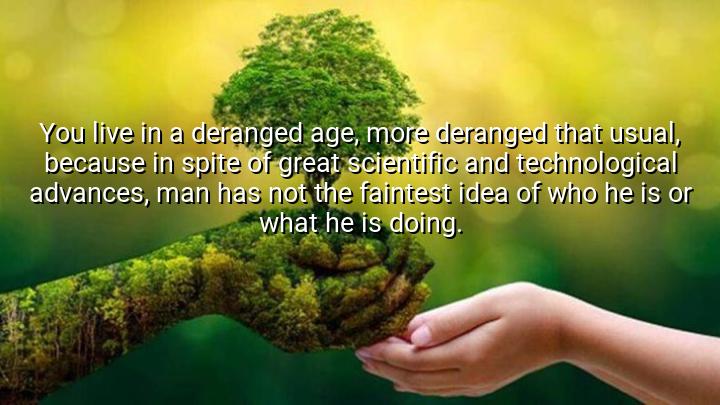




Walker Percy’s quote, "You live in a deranged age, more deranged than usual, because in spite of great scientific and technological advances, man has not the faintest idea of who he is or what he is doing," critiques the paradox of modern society. While we have made tremendous strides in science and technology, these advancements have not necessarily translated into a deeper understanding of our humanity or our purpose. Percy suggests that the more we advance in material and intellectual realms, the more disconnected we become from our true selves.
The use of the term deranged conveys a sense of confusion and disarray, highlighting the irony that even with our immense progress, we seem to be more lost than ever in terms of self-awareness. Percy points out that technological and scientific progress, although impressive, has not provided the clarity needed to understand the fundamental questions of life, such as the nature of our existence and our purpose in the world.
Walker Percy, a novelist and essayist, was known for exploring existential themes and the complexities of the human condition. His work often dealt with the tension between technological progress and the emotional, spiritual, and philosophical needs of individuals. This quote reflects his belief that, despite all of our external achievements, we are still struggling to understand ourselves on a deeper level.
In essence, the quote serves as a reflection on the limitations of modernity. While society has made significant advances in many fields, it has not necessarily led to greater fulfillment or a clearer sense of identity. Percy’s message encourages us to examine the disconnect between our technological progress and our human needs, urging us to find meaning beyond the achievements of modern society.

HVThuy Huong Vuong
It’s sobering to think that despite all our tools and innovations, we remain so uncertain about our place in the world. Does this uncertainty paralyze action or motivate deeper inquiry? I also wonder if this disconnect contributes to feelings of alienation and anxiety common today. How can individuals cultivate a clearer sense of identity amid such a confusing and fast-paced age? This quote invites reflection on balancing external progress with internal clarity.
MHLe Hoang Mai Huong
This quote makes me question if our identity crisis is linked to how we define ‘man’ or ‘human.’ Are we still using outdated concepts in a world transformed by technology? Maybe the derangement comes from trying to fit new realities into old frameworks. How might new philosophies or ways of thinking help us better grasp our purpose and actions? I’m curious about how different cultures approach this tension between knowledge and self-understanding.
NMNguyen Ngoc Minh
I’m intrigued by the use of ‘deranged’ to describe our age—it implies chaos and loss of sanity. Does this mean that progress without understanding leads to madness? If so, what role should philosophy, spirituality, or art play in helping us find ourselves? Also, how does this insight apply to current issues like climate change or social unrest? This quote feels like a call to integrate knowledge with deeper self-awareness.
VHVo Hinh
Reading this, I feel a deep sense of frustration mixed with truth. It’s alarming that despite incredible achievements, humanity struggles with identity and direction. Could this derangement be due to the pace of change overwhelming our capacity for reflection? Or is it rooted in education, culture, or values? This quote challenges me to think about how society can foster wisdom and meaning alongside scientific growth. Is it too late to bridge that gap?
MA9b Vu minh anh
This quote strikes me as a profound critique of modern society, highlighting a disconnect between our technological progress and our self-awareness. How can we advance so far in science yet remain so lost about our own purpose? Does this suggest that technology alone can’t solve existential questions? I wonder if this confusion is a fundamental human condition or a unique crisis of our era. How might we begin to reclaim understanding of who we are amid rapid change?