

You just never know when you're living in a golden age.
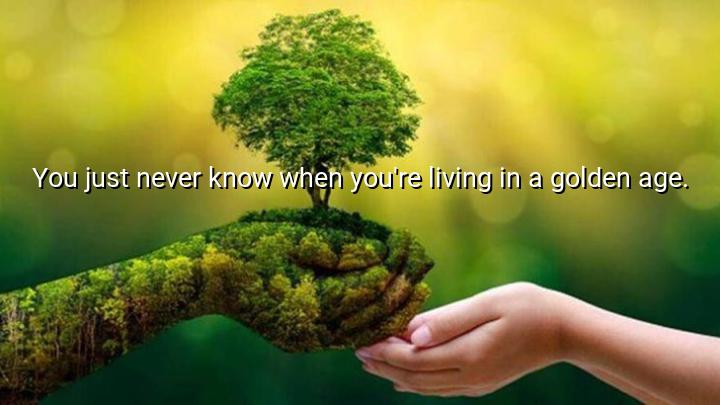




In this quote, Alexander Payne, an American filmmaker known for his thought-provoking movies, reflects on the unpredictability of recognizing a golden age while you're living through it. He suggests that it is often difficult to understand when we are in the midst of a period of greatness or cultural significance, as these moments are usually only fully appreciated in hindsight. Payne’s words emphasize how we may fail to recognize the value of certain times or experiences until they have passed.
The notion of a golden age generally refers to a period of prosperity, peace, or cultural achievement. Payne’s point is that such an age may feel ordinary or even challenging when you're experiencing it, making it hard to recognize the historical importance of the moment in real-time. In other words, a golden age is not always marked by extraordinary circumstances but by how it is remembered and valued after the fact.
The origin of this quote likely comes from Payne’s personal and professional experiences, as he has observed both the human condition and the way society perceives its own progress. As a director, Payne’s films often deal with themes of self-reflection, the passage of time, and the complexities of life, all of which are tied to how we view and interpret our own moments of cultural or personal significance. His perspective invites people to reflect on their own lives and societies and question what they may be overlooking.
Ultimately, Payne’s words remind us to appreciate the present moment and recognize the value of what we are living through. Often, we may fail to see the richness or importance of our experiences in the midst of them, but in retrospect, those moments could be viewed as part of a golden age. His quote encourages us to be more mindful of our times and more reflective about the meaning they might hold in the larger context of history.

MNhuynh man nhu
Such a poignant reminder of how subjective history and memory are. We often rely on future perspective to name something a golden age—whether it’s in film, politics, technology, or even personal life. But it raises a question for me: if we don't know in the moment, does it matter? Is the purpose of a golden age to be lived or simply to be remembered?
TPThuong Pham
It makes me a little anxious, honestly. If we can’t tell when we’re in a golden age, what else are we missing? Are we living in one right now and wasting it on stress and distraction? Maybe we need to be more intentional about gratitude and awareness. I’m starting to think that part of recognizing a golden age comes down to mindset more than historical significance.
HNHong Nguyen
This line hits hard. It kind of makes me wonder if the concept of a 'golden age' is more about perception than reality. Are we always living through some kind of golden age, but only notice it when things get worse later? Or are we too distracted, too caught up in our problems to realize how good we actually have it sometimes? It’s a humbling thought.
YVYen Vii
I think there's something bittersweet here. It suggests that the most meaningful moments might pass us by unrecognized. It makes me want to pay closer attention to the small joys and victories of everyday life. Could we train ourselves to be more present so we don’t miss the significance of what’s happening around us? Or are golden ages only visible through the lens of hindsight?
QCLai Quynh Chi
This quote really makes me reflect on how easy it is to overlook the beauty or importance of the present moment. Why is it that we often only recognize the value of an era once it's gone? Maybe nostalgia filters our memories, but I wonder what we’re missing right now—what parts of our lives we’ll look back on and think, 'That was it. That was the golden time.'