

Worrying about the poor is one thing. To contend that equality is necessary for growth is an altogether different and more radical idea.
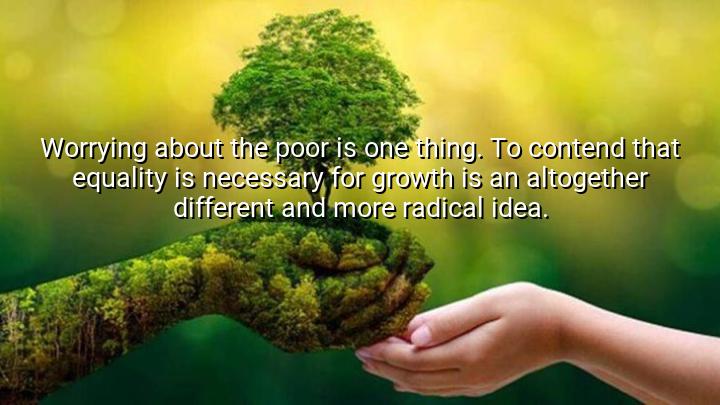




Chrystia Freeland’s quote distinguishes between two related but different approaches to economic and social issues. She acknowledges that worrying about the poor is a common concern, but she argues that the more radical idea is the belief that equality is necessary for growth. Freeland suggests that addressing poverty is often viewed as a charitable or philanthropic act, but asserting that equality—in terms of access to resources, opportunities, and rights—is essential for sustained economic growth requires a deeper and more systemic shift. The quote challenges the prevailing notion that growth can occur without considering the social equity that underpins it.
The origin of this quote comes from Chrystia Freeland's work as a politician and journalist, where she has often discussed economic policies and the challenges of creating more equitable societies. As a Canadian minister and former editor at The Financial Times, Freeland has written extensively about the connections between globalization, economic inequality, and the need for more inclusive growth. Her perspective reflects her belief that addressing the root causes of inequality is not just a moral imperative but an economic necessity for long-term prosperity.
Freeland’s comment also touches on the idea that growth—whether economic or social—cannot be achieved in a society where significant inequalities exist. By emphasizing that equality is not only a moral goal but a driver of growth, she challenges the idea that economic progress can happen in a vacuum, without taking into account how resources are distributed across different segments of the population. Her point is that true sustainability and progress require equitable access and opportunities for all members of society.
Ultimately, Freeland’s quote calls for a rethinking of how growth is defined and achieved. It suggests that equality is not just a desirable goal but a foundational principle that enables the kind of growth that benefits society as a whole. By framing equality as a radical but necessary idea for progress, she challenges traditional economic assumptions and advocates for a more inclusive, sustainable approach to economic development.

AAdministratorAdministrator
Welcome, honored guests. Please leave a comment, we will respond soon