

Without words, without writing and without books there would be no history, there could be no concept of humanity.
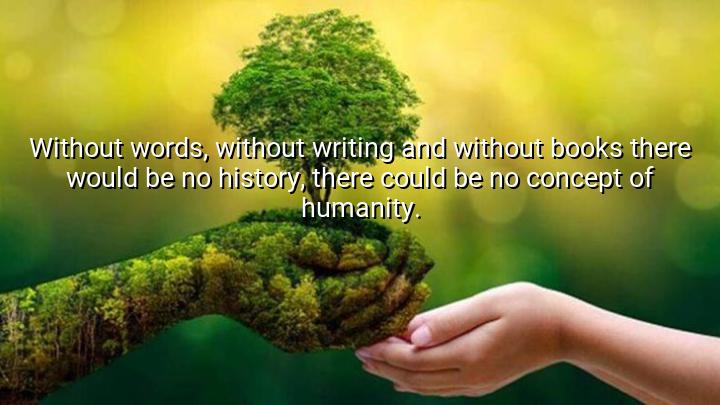




Hermann Hesse’s quote, "Without words, without writing and without books there would be no history, there could be no concept of humanity," emphasizes the crucial role that language and written records play in shaping human civilization. Hesse argues that without the ability to express ourselves through words, whether spoken or written, there would be no way to document or preserve the events that have shaped our past. History as we know it relies on the transmission of knowledge and experiences, which is made possible through the written word.
The mention of books highlights the importance of written records in preserving the stories, wisdom, and lessons of past generations. Without books, societies would struggle to pass down their cultural heritage, achievements, and mistakes to future generations. Writing provides the foundation for the continuity of human knowledge, enabling the concept of history to exist and evolve across time and space. Hesse suggests that, through writing, humanity can reflect on its journey and better understand its place in the world.
Hesse’s point also speaks to the idea that humanity itself is deeply intertwined with the ability to communicate, to reflect on existence, and to preserve memories. He implies that it is through written language that people develop a collective identity and sense of shared experience. Without these tools, humans might lack the framework needed to understand their own evolution and the broader forces that shape societies.
The origin of this quote lies in Hesse’s broader exploration of philosophical and humanistic themes, particularly in his works like Steppenwolf and Siddhartha. As a writer and thinker, Hesse was deeply concerned with the relationship between individuals, culture, and society, often emphasizing the importance of self-awareness and personal reflection. In this quote, Hesse underscores the vital role that the written word has played in the development of civilization and human consciousness, stressing that without it, humanity would be deprived of the means to understand its own story.

AAdministratorAdministrator
Welcome, honored guests. Please leave a comment, we will respond soon