

Why should 20-year-olds only be considered sexy? I think we get better with age.
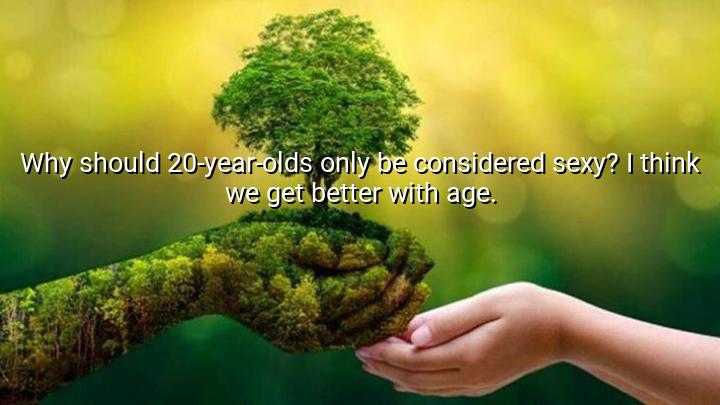




In this quote, Jenny McCarthy, an American actress and television personality, challenges the societal notion that youth is the only period in a person’s life when they are considered attractive or sexy. McCarthy questions why only 20-year-olds are seen as the epitome of beauty and desirability. She asserts that people improve with age, implying that both physical and personal attributes, such as confidence, maturity, and experience, often make individuals more appealing as they grow older.
McCarthy’s statement challenges the common ageist perspective that associates youth with attractiveness and implies that aging brings a deeper sense of self and empowerment. By celebrating the idea that one can “get better with age,” she is promoting a more inclusive and positive view of aging, where beauty is not limited to a specific age group. This mindset encourages individuals to appreciate themselves at every stage of life, seeing aging as something that adds value rather than diminishes it.
The origin of this quote comes from McCarthy’s own experiences as a public figure who has been in the spotlight for many years. As a model and actress, she was initially part of the entertainment industry’s focus on youth and appearance. Over time, she has become an advocate for self-acceptance and confidence at any age, challenging the rigid beauty standards that often define women in the entertainment industry.
Ultimately, McCarthy’s words encourage a shift in perspective, one that recognizes the ongoing growth and evolution of individuals throughout their lives. Her quote serves as a reminder that beauty and attractiveness are not confined to youth, and that with age comes wisdom, experience, and a deeper understanding of oneself, which can enhance one’s appeal.

ANAnh Ngoc
Such a powerful point. It challenges the ageist lens we’re constantly looking through, especially for women. Why is it that wisdom, strength, and even sensuality somehow become invisible past a certain age? If anything, aging adds richness to a person. Maybe we need more visible role models who embody this mindset—not just celebrities, but everyday people who radiate confidence and authenticity beyond their twenties. Isn’t that the sexiest trait of all?
PLPham Luu
I feel conflicted. On one hand, yes, age can enhance confidence and make people more interesting. On the other, beauty and sex appeal still seem tightly tied to youth in most cultures. So is this quote hopeful realism or just wishful thinking? Maybe we get better with age in many ways—but do others see that, or only those living it? I’d love to hear how people in different age groups relate to this idea.
TNThuong Nguyen
Honestly, I love this energy. It’s refreshing to hear someone challenge the obsession with youth. I’ve found that people often grow into themselves later in life—they know what they want, they’re more secure, and that confidence is so magnetic. But I do wonder, will the media ever catch up? Or will we always have to fight to redefine what’s sexy, what’s valuable, what’s desirable? It feels like a long overdue cultural shift.
MTMinh Thu
I get what she's saying, but it makes me wonder—how much of this is personal empowerment versus a response to societal pressure? Are we truly embracing aging, or just trying to reframe it so we don’t feel left out of youth-centric beauty standards? Either way, I agree: attraction shouldn’t have an age cap. But how do we make that idea mainstream when industries still worship youth in ads, films, and magazines?
112
This really hits home for me. It’s frustrating how society clings to such a narrow standard of beauty. Why is attractiveness often framed as something that expires after 30? Confidence, emotional depth, and experience are incredibly appealing—maybe even more so than youthful looks. What would it take to shift cultural mindsets to celebrate those qualities instead of constantly glorifying youth? I think aging should be embraced, not feared or hidden.