

While the digital age has done so much to improve our world, it has dramatically changed our social structure, often further isolating us from each other.
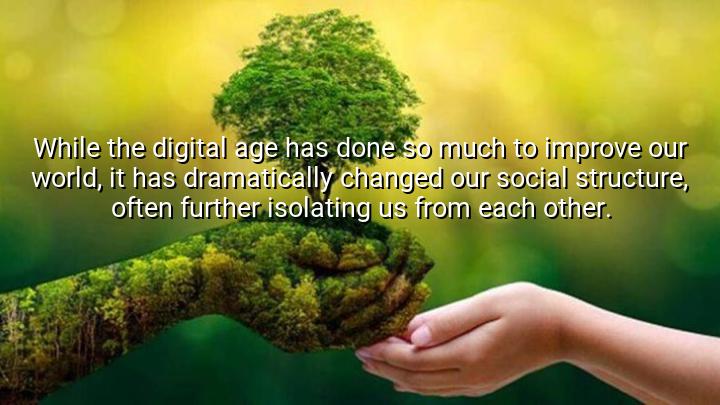




Dean Ornish’s quote highlights the dual nature of the digital age, acknowledging its benefits while also pointing out its negative impact on social structure. He recognizes that the advancements in technology have undoubtedly brought about improvements in various aspects of life, such as communication, information access, and convenience. However, Ornish also cautions that the rise of digital technology has led to unintended consequences, particularly in terms of how it affects our social interactions.
Ornish emphasizes that while digital tools have made it easier for people to connect across vast distances, they have also contributed to a sense of isolation. In a world where social media and digital communication are often the primary means of interaction, people can find themselves distanced from face-to-face connections. This digital shift has led to a paradox where, despite being more connected online, many individuals may feel more disconnected in real life, leading to weakened social bonds and a breakdown in traditional community structures.
The quote underscores the impact of technology on human relationships, suggesting that while we benefit from the convenience and reach of the digital world, there are trade-offs. The reliance on digital platforms for social interaction can diminish the depth and authenticity of personal relationships, making people feel more lonely or disconnected from the world around them.
Ultimately, Ornish’s quote serves as a reminder that technological advancements must be balanced with the need for genuine human connection. While the digital age offers many advantages, it also calls for a critical reflection on how we maintain meaningful relationships and preserve the social fabric of our communities in an increasingly virtual world.

ALAnh Le
There’s definitely truth in this observation. I’ve noticed how even gatherings now have people glued to their phones, barely engaging with those around them. It feels like digital interaction has become the default, even when we’re physically together. Do we need a cultural reset—some kind of collective movement—to relearn the value of uninterrupted human presence?
TNThanh Ngo
This quote made me reflect on how we define connection in the digital age. Are likes, comments, and messages really a substitute for sitting across from someone and sharing a moment? I fear we’re forgetting how to be present with each other. How can we reclaim genuine relationships in an environment that constantly pulls our attention away?
TVTruc Vy
I find this statement really thought-provoking. Has our obsession with convenience and instant communication led to a loneliness epidemic? It seems ironic that tools meant to enhance connectivity are now contributing to isolation. I wonder what role tech companies should play in addressing this. Should platforms have a responsibility to promote real-world interaction, or is it up to us as users?
7H7749 Hung
Dean Ornish makes a powerful point, but I’m curious—is it the technology itself that isolates us, or how we choose to use it? Social media, for instance, can either bring people together or drive them apart depending on intent and design. Maybe we need to shift the conversation from blaming the digital age to rethinking how we build community in a virtual world.
ATanh thu
This quote hits home. I often feel like I’m more connected than ever digitally, yet more disconnected in real life. Do you think our increasing reliance on screens has replaced meaningful face-to-face interaction? It’s like we’ve traded physical presence for constant availability—but at what cost to our mental and emotional well-being? I wonder if we're even aware of how isolated we've become.