

When you get to a certain age, there is no coming back.
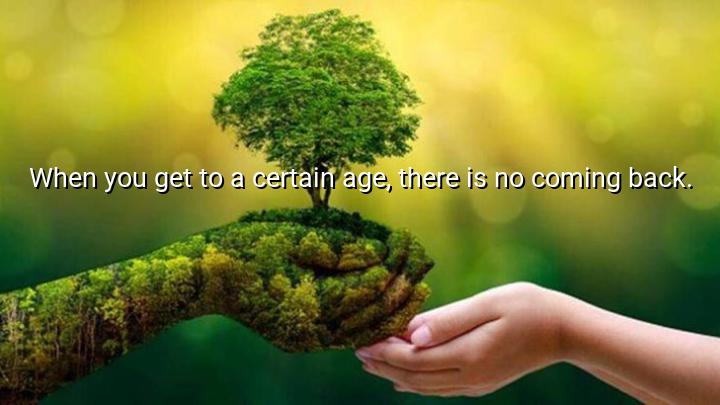




In this quote, Brian Clough, a legendary English football manager, reflects on the inevitability of aging and the point at which it becomes impossible to reverse the process. By saying, “When you get to a certain age, there is no coming back,” Clough acknowledges that time and age are irreversible forces in life. No matter how much one tries to maintain youth or fight against the effects of aging, there comes a point where the changes are permanent, and recovery or return to a younger state is impossible.
Clough's words highlight the realization that aging is a natural and unavoidable part of life. This perspective is particularly relevant in the context of his career in professional sports, where youth and physicality are often seen as vital to success. Clough's comment suggests that the physical and mental toll of age on athletes, managers, or anyone in a demanding career, cannot be undone once certain milestones are reached.
The quote also reflects a sense of acceptance and perhaps even resignation toward the aging process. Clough, who was known for his sharp wit and straightforward attitude, may be implying that there is no use in denying or trying to escape the effects of aging. Instead, it's about recognizing when one has reached that inevitable stage and embracing the reality that, from that point forward, life will unfold in new ways, with different limitations and opportunities.
Ultimately, Brian Clough’s quote serves as a reminder of the inevitability of aging and the importance of understanding and accepting one's limitations as they grow older. It highlights the need for individuals to adapt to their changing circumstances and accept that, at a certain age, there is no turning back.

NNu
Reading this quote gives me a strange mix of motivation and fear. On one hand, it pushes me to take action now, to not wait for some perfect future. On the other, it implies there’s a looming expiration date on growth or redemption. I’d love to ask Clough: was this about football, life in general, or his own personal journey? Because the context might change everything.
NDNguyen Duy
What age is Clough referring to here? That’s what I keep asking myself. Because if 'no coming back' means you’ve reached a stage where second chances are gone, it feels a bit grim. But maybe it’s also a reminder to live fully before that moment arrives. Still, I wonder whether this kind of thinking encourages defeat or inspires urgency. Is it a warning or a resignation?
HHuy
This feels like something only someone with years of experience—and possibly regret—would say. It’s raw and brutally honest, but is it universally true? There are people who find new love, careers, and meaning even after 'a certain age.' So I’m curious: does this quote reflect a personal limitation or a broader societal belief we need to challenge? It leaves me with more questions than answers.
TTTran Tuan
Honestly, this quote makes me feel uneasy. It sounds final, like a door closing that can never be reopened. But maybe that's the point—acknowledging that aging brings irreversible changes. Still, is there a way to shift that perspective toward acceptance and growth rather than loss? I'd love to hear what others think: is this quote realistic, or is it too defeatist for today’s world where longevity and health are improving?
NPQuynh Nhi Pham
Clough’s quote hits hard, especially in a culture obsessed with youth and comeback stories. Is it really true that once you hit a certain point, it’s all decline? Or is it more about society’s perception than actual ability? I've seen people reinvent themselves in their 60s or 70s. So I wonder: is this about physical limits, or is it an attitude we internalize over time?