

When it is a question of money, everybody is of the same religion.
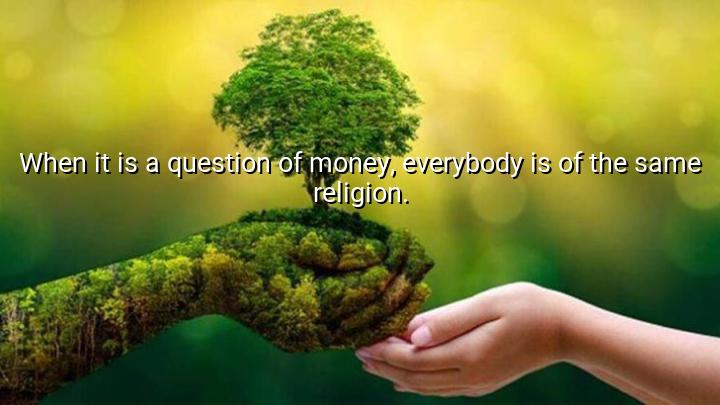




The quote "When it is a question of money, everybody is of the same religion" by Voltaire highlights the universality of financial interests, suggesting that when it comes to wealth and power, all divisions between people—whether they are based on religion, nationality, or social class—are set aside. Voltaire, a key figure in the Enlightenment and a staunch critic of both organized religion and political power, uses this statement to underscore the idea that, in the face of economic interests, personal beliefs and affiliations become secondary. The pursuit of money transcends religious and ideological boundaries, uniting people regardless of their otherwise contrasting views.
Voltaire’s critique in this quote reflects his broader skepticism about human nature and societal systems. He often attacked hypocrisy in both religion and politics, arguing that while people might profess strong religious or moral beliefs, their actions—especially when it comes to accumulating wealth—often reveal the self-interest that governs their behavior. In this context, the quote is a sharp commentary on how the pursuit of material gain often trumps higher ideals, revealing the tension between personal morals and social or economic ambitions.
The phrase "everybody is of the same religion" is also significant because it frames money as a kind of universal force that everyone worships, regardless of their specific spiritual beliefs. Voltaire, by comparing money to a religion, emphasizes how people can be just as devout and zealous in their pursuit of wealth as they are in their adherence to traditional faiths. This comparison suggests that economic pursuits can become a form of idolatry, where people are driven more by the desire for material success than by the pursuit of moral or spiritual fulfillment.
In essence, Voltaire's quote serves as a reflection on the corrupting influence of wealth and its ability to unite people across divides, but not in a positive or unifying way. It speaks to the human tendency to prioritize material concerns over ethical or religious values, questioning the sincerity of individuals who, while claiming adherence to higher principles, are ultimately driven by financial motives.

AAdministratorAdministrator
Welcome, honored guests. Please leave a comment, we will respond soon