

When I was born, my parents and my mother's parents planted a dogwood tree in the side yard of the large white house in which we lived throughout my boyhood. This tree I learned quite early, was exactly my age - was, in a sense, me.
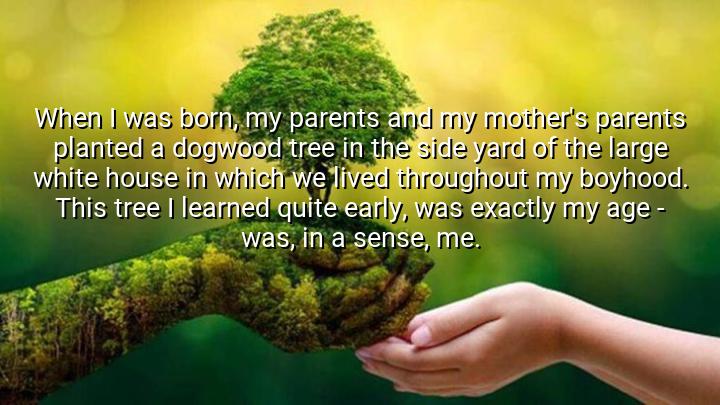




In this quote, John Updike, an American author, reflects on his deep connection to a dogwood tree that was planted by his parents and maternal grandparents when he was born. The tree, positioned in the side yard of the family home, serves as a symbolic marker of his growth and identity. Updike suggests that as he grew up, the tree became intertwined with his own sense of self, as it "was exactly my age"—its growth and development mirrored his own life, making it feel like a part of him.
By describing the tree as "me," Updike emphasizes the personal bond he developed with this natural object. The tree, growing alongside him, represented a constant in his life, witnessing the changes and milestones that occurred over time. The image of the tree thriving as he did serves as a powerful symbol of life and continuity, with the tree acting as a silent observer and participant in his journey through childhood and beyond.
The origin of this quote comes from Updike’s reflections on his early years in a specific, meaningful place—the large white house where he spent his boyhood. The tree serves as a metaphor for his own experience of growth, rooted in a familiar and comforting environment. Updike often used personal memories and experiences in his work, and this tree symbolizes not just his physical growth but the deep connections he formed with his family and surroundings.
Ultimately, Updike’s words explore the idea of personal identity being shaped by the natural and familial environments in which we grow. The dogwood tree, planted at the moment of his birth, becomes a physical representation of his own life, signifying that we are often linked to the places and things that accompany us through our journey. The tree’s presence in his story serves as a reminder of the continuity of life and the meaningful symbols that accompany us throughout our growth.

TT38-Nguyen Tu Tran-7A10
What an introspective and delicate memory. I’m fascinated by how Updike assigns identity to the tree—not just as a symbol of himself, but as a parallel life. It's a reminder that identity can be rooted in more than just thoughts and experiences; it can also be planted, watched, and quietly nurtured. Does anyone else feel like parts of their past are stored in objects or nature like this?
QNquyen nguyen
I can’t help but feel a kind of gentle sadness reading this. There's nostalgia baked into every word, the kind that only comes from looking back at childhood through the lens of adulthood. The fact that he equates the tree with himself—was, in a sense, me—raises philosophical questions. Can we find pieces of ourselves in the natural world, or is it just our way of holding onto time?
TNTruong Thi Tuyet Nhi
This makes me wish more families had rituals like this. Planting a tree for a newborn is such a beautiful act of hope and continuity. It also prompts a question: in our fast-paced, digital age, are we losing these symbolic ties to place and nature? I feel inspired to start something similar—a tree, a tradition, something enduring—when someone I love enters the world.
YNtran thi yen nhi
There’s something both touching and haunting in this memory. It captures how we often project ourselves into the world around us, and how physical symbols—like trees or houses—become containers for our identities. I'm curious: did that tree give him comfort or pressure? Knowing something living reflected his age and growth might have created a quiet sense of expectation or companionship.
QTQuang Truong
I find this incredibly poetic. The metaphor of a tree planted at birth, growing as the person grows, is a profound way to tie human life to nature. It makes me reflect on how rarely we pause to consider such tangible representations of ourselves in the world. I wonder what happened to that tree—and whether its fate paralleled Updike’s own emotional or personal journey.