

When humans team up with computers to play chess, the humans who do best are not necessarily the strongest players. They're the ones who are modest and who know when to listen to the computer. Often, what the human adds is knowledge of when the computer needs to look more deeply.
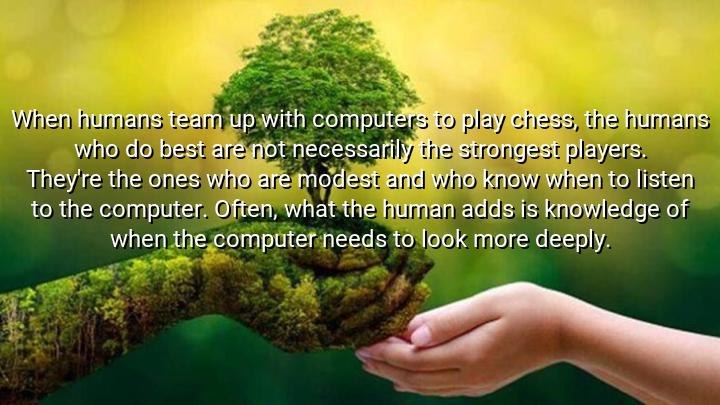




Tyler Cowen’s quote emphasizes the collaborative nature of playing chess with computers, where the best outcomes are not necessarily achieved by the strongest players. Instead, Cowen points out that the most successful human players are those who are modest and understand when to defer to the computer's analysis. This suggests that while computers are highly capable of analyzing vast numbers of possible moves, human success in these collaborations depends on knowing when to trust the computer's calculations and when to provide additional insight based on human intuition and strategic understanding.
Cowen highlights that the human role in this partnership often goes beyond just making moves—it involves knowing when to guide the computer to dig deeper into certain positions. This is where human knowledge and experience come into play: while the computer may excel at performing calculations, the human player is crucial in understanding the context of the game, knowing when to explore specific positions more thoroughly, and offering a broader perspective that the computer may not recognize on its own.
The quote also speaks to the value of humility and the ability to listen in a partnership. Cowen argues that the strongest human players in this scenario are not those who are overconfident in their own abilities but those who are open-minded and willing to learn from the computer. This reflects a broader philosophy about the synergy between technology and humanity, where both can complement each other’s strengths.
Tyler Cowen, an economist and public intellectual, is known for his work on technology and its impact on various aspects of life, including decision-making and problem-solving. His quote likely stems from his observations on how technology, particularly in fields like chess, can enhance human performance, but only when people recognize the importance of collaboration with machines. Cowen’s perspective encourages us to think critically about how we work with artificial intelligence and technology to achieve better results through cooperation rather than competition.

AAdministratorAdministrator
Welcome, honored guests. Please leave a comment, we will respond soon