

When grace is joined with wrinkles, it is adorable. There is an unspeakable dawn in happy old age.
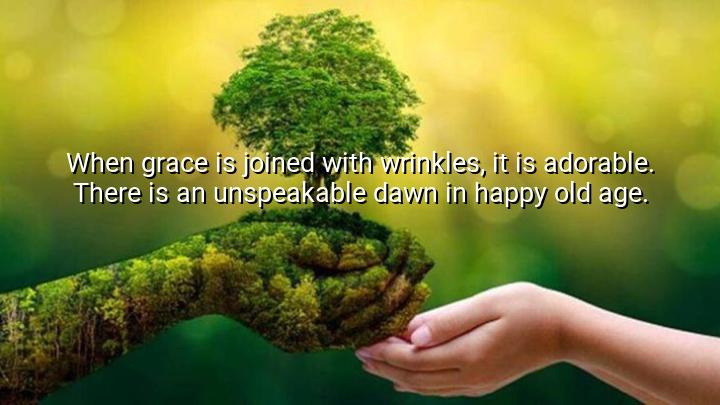




The quote "When grace is joined with wrinkles, it is adorable. There is an unspeakable dawn in happy old age" by Victor Hugo reflects a deep appreciation for the beauty and dignity that can accompany the aging process. Hugo, a renowned French writer and poet, suggests that aging does not diminish a person’s grace or charm. Instead, when wrinkles and the signs of age are paired with grace, they become a symbol of the wisdom, experience, and peace that come with a life well-lived. The term “adorable” here indicates that the combination of age and grace is not only acceptable but highly appealing.
Hugo’s words suggest that old age should not be viewed as something to fear or hide, but rather as a phase of life that holds its own kind of beauty. The wrinkles on an older person’s face are seen not as flaws, but as marks of a life filled with experiences, challenges, and triumphs. In this way, age, when embraced with grace, becomes a kind of natural beauty, reflecting the person’s inner strength and acceptance.
The phrase "there is an unspeakable dawn in happy old age" adds another layer to the quote, implying that with happiness in old age comes a sense of renewal and peace. The dawn symbolizes a new beginning, suggesting that old age can be a time of serenity, where one can enjoy the fruits of a long life and look forward to the future with optimism. The idea of an "unspeakable" dawn indicates that this stage of life brings a profound sense of joy that cannot fully be captured in words.
Ultimately, Hugo’s quote invites us to view aging as a celebration rather than a decline. When accompanied by grace and happiness, the signs of age are not something to be feared or hidden but embraced as a beautiful reflection of a life well lived. It reminds us that old age, when filled with contentment, has its own unique and invaluable beauty.

QNQuynh Nhu
Reading this quote makes me think of my grandparents. They had such gentleness and humor even in their later years—it was beautiful, really. But I wonder, how much of that 'adorable grace' is natural, and how much is learned? Is aging with happiness something we can cultivate early on, or is it just a lucky alignment of personality and life circumstances?
Xxuanhoang1234
I’m intrigued by Hugo’s idea of a 'dawn' in old age. Most people think of aging as a sunset, not a new beginning. Could this mean that wisdom, peace, and emotional freedom in later life actually outweigh the vitality of youth? How might we reframe retirement or elderhood to reflect this kind of awakening rather than decline?
YYu
There's something poetic and almost spiritual in this quote. I like the idea that aging, when embraced with grace, can bring about a kind of rebirth or new clarity. Do you think this idea can shift how we talk about getting older? Maybe we should start highlighting these kinds of stories more—those who age with joy and purpose—as models of aging well.
CHquang cong ho
Victor Hugo paints such a hopeful picture of aging. But it makes me wonder: is it possible for everyone to experience a 'happy old age'? What happens to those who face loneliness, illness, or regret in their later years? Can grace still shine through suffering, or is happiness in old age mostly a privilege tied to circumstances like health and community support?
SCSau Ca
This quote really touched me. It feels like a reminder that aging doesn’t have to mean fading away—it can mean becoming more radiant in a different way. Why do you think our culture so often ignores or even fears the beauty of aging gracefully? Isn’t there something deeply moving about someone who’s lived fully and carries that life in their face, their attitude, their spirit?