

What turns me on about the digital age, what excited me personally, is that you have closed the gap between dreaming and doing. You see, it used to be that if you wanted to make a record of a song, you needed a studio and a producer. Now, you need a laptop.
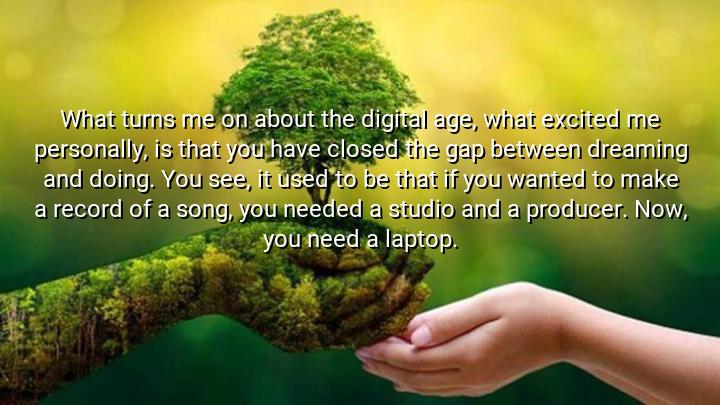




The quote, "What turns me on about the digital age, what excited me personally, is that you have closed the gap between dreaming and doing. You see, it used to be that if you wanted to make a record of a song, you needed a studio and a producer. Now, you need a laptop," comes from Bono, the lead singer of the Irish rock band U2. In this statement, Bono expresses his excitement about the possibilities opened up by the digital age and how technological advancements have transformed the creative process. He focuses on how digital tools have democratized artistic creation, allowing anyone with a laptop to produce high-quality work, like music, without the need for expensive equipment or professional intermediaries.
Bono's reference to "closing the gap between dreaming and doing" highlights how the digital age has made it easier for individuals to turn their creative ideas into reality. In the past, creating music or other forms of media required access to specialized resources, such as a recording studio or a professional producer. These barriers meant that many creative individuals had limited opportunities to produce their work. However, with the advancement of digital technology, the process has become more accessible, as artists can now produce and record content with just a laptop and basic software.
The shift from needing a physical studio to using a laptop emphasizes the impact of technology on the music industry and other creative fields. Bono points out that the tools needed to create something as complex as a song are now much more accessible, lowering the barriers to entry for artists. This represents a broader trend in the digital age, where technology allows people to bypass traditional gatekeepers and pursue their creative goals independently.
Ultimately, Bono’s quote reflects his appreciation for the empowerment provided by digital tools. He celebrates the idea that the digital age has made it possible for more people to engage in the creative process without relying on traditional, costly infrastructure. This transformation represents a shift in how art is made, shared, and experienced, with the potential to unlock creative possibilities for a global audience.

HNPham Hong Ngoc
I appreciate Bono’s perspective here—it’s a hopeful reminder that we’re living in an era of possibility. But I also feel there's a tension: with the tools so widely available, are we encouraging creativity, or diluting it? Does this ease of access mean we take creation less seriously, or does it open doors for voices that would’ve never been heard otherwise? It’s a double-edged sword worth exploring.
NTnguyen thao
This quote really got me thinking about creativity and ownership. It’s amazing that artists no longer need permission from studios or labels to share their work. But are we risking undervaluing art now that it’s so easy to produce and distribute? If everyone’s a creator, how do we maintain a sense of artistic craft and depth in a world of instant content?
HKhoc Khoa
What Bono says reminds me that technology is a tool, not a guarantee. Sure, the barriers to entry are lower, but the need for dedication, skill, and vision hasn’t gone away. Are we sometimes lulled into thinking it’s easy just because it’s possible? I think the digital age makes dreaming easier—but turning that dream into something meaningful still takes real effort.
MAMin Ad
There’s something really inspiring here. The idea that the gap between dreaming and doing is now smaller than ever feels empowering. It makes me want to go chase my own projects instead of waiting for the 'right' resources or moment. But then again, does this access sometimes make people feel like they have to compete constantly just to be seen? Are we more free—or more overwhelmed?
TSCheng Thi Suy
Bono’s excitement is contagious. It's amazing to think how far we’ve come—anyone with a laptop can make music, write books, build apps. But I can’t help but question whether this democratization of tools has actually led to more people finishing their creative projects, or just starting them. Has removing the barriers made us more productive—or just more distracted by endless possibilities?