

What makes old age hard to bear is not the failing of one's faculties, mental and physical, but the burden of one's memories.
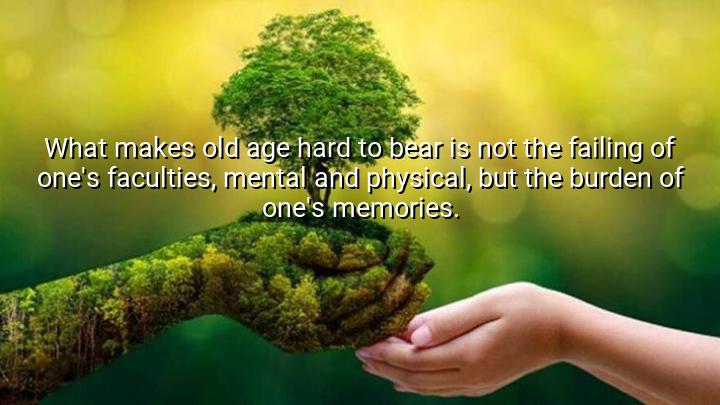




In this quote, W. Somerset Maugham suggests that the true challenge of old age is not the natural decline in physical and mental abilities, but the weight of one's memories. As we grow older, our bodies and minds may become less capable, but Maugham argues that the real difficulty lies in the emotional burden that comes from recalling past events. The accumulation of memories, both pleasant and painful, can be overwhelming and often lead to feelings of regret, nostalgia, or sadness.
Maugham’s insight highlights the complex relationship between aging and memory. While we may think of the physical aspects of aging—like the loss of strength or clarity—being the most difficult, it is often the memories of the past that can be more burdensome. These memories are not easily escaped and may bring up unresolved emotions or experiences that make the later years feel heavy. The quote underscores how memory can shape our emotional well-being as much as the physical changes of old age.
The idea that memories can be a burden contrasts with the common notion of old age as a time for reflection and wisdom. Maugham acknowledges that as we age, we may look back on our lives with a sense of loss, longing, or sorrow, especially if we have experienced hardship or missed opportunities. The weight of these memories can overshadow the natural acceptance that often comes with aging, making it harder to find peace in the present.
Ultimately, W. Somerset Maugham’s quote speaks to the emotional complexity of growing older. It suggests that the challenges of old age are not just physical but also psychological, as the past, with all its memories, shapes how we experience the present. The burden of these memories can make it more difficult to navigate later years with the same ease and freedom as before, emphasizing the emotional toll that accompanies the passage of time.

LHTran Le Hieu
Does this suggest that unresolved emotional pain is the real enemy of aging? If we can’t make peace with our past, does that mean we’ll carry it more heavily later in life? I think this perspective challenges our whole approach to aging—we often focus so much on health and finances, but what about emotional closure? Should therapy or introspection be as much a part of preparing for old age as retirement planning?
NYTran Huynh nhu y
I’m a little unsettled by this quote because it makes aging sound emotionally exhausting. But is that really true for everyone? What about people who reflect on their lives with pride or gratitude? Maybe it’s not the memories themselves, but how we relate to them that matters. So is Maugham being universally accurate, or is this a more melancholic take specific to his worldview or generation?
LTPhuc nguyen Le tran
This raises a powerful question: can we prepare ourselves for old age not by preserving youth, but by finding peace with our past? If memories become burdens, maybe the work of youth and middle age is to process and forgive—to let go as much as we hold on. I wonder how many people enter old age haunted rather than comforted by their life stories. And what can we do to shift that narrative?
TSVu Dang Thai Son
Wow, I hadn’t thought about aging this way. I’m curious if Maugham is speaking from personal experience or from observation. Do people really suffer more from their pasts than from their present? It makes me reflect on how we tend to glorify memories as treasures—but here they’re framed almost like chains. Is that a universal truth, or something that only applies when one’s past is particularly painful or unresolved?
BMquoc bao mai
I find this quote deeply poignant and a little haunting. It makes me wonder: is the problem the memories themselves, or the inability to change them? If you carry guilt, loss, or missed opportunities into old age, is that what weighs you down the most? And if so, can emotional processing earlier in life lighten that burden later? Is emotional healing just as crucial to aging well as physical health?