

What is the worst of woes that wait on age? What stamps the wrinkle deeper on the brow? To view each loved one blotted from life's page, And be alone on earth, as I am now.
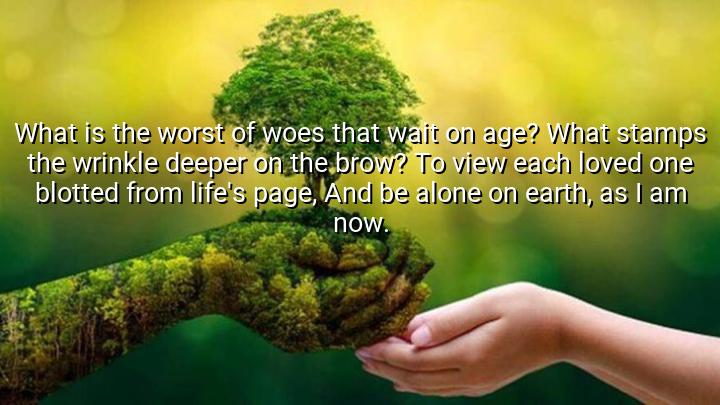




Lord Byron’s quote, "What is the worst of woes that wait on age? What stamps the wrinkle deeper on the brow? To view each loved one blotted from life’s page, And be alone on earth, as I am now," reflects the emotional and psychological challenges that come with aging. Byron is expressing the profound sorrow that accompanies the loss of loved ones and the isolation that can result as one grows older. He suggests that the greatest sorrow in old age is not just physical decline, but the loneliness that comes from seeing those closest to you pass away.
The mention of a wrinkle deepening on the brow symbolizes the visible signs of aging, and how they are not just a result of time passing but also a reflection of the emotional burden of loss. Byron asks what the "worst of woes" is in old age, implying that the emotional toll of losing loved ones is one of the most difficult aspects of getting older. This sorrow is more profound than any physical changes, as it affects both the heart and the mind.
Byron, a prominent Romantic poet, often explored themes of melancholy, love, and death in his works. This quote can be seen as a reflection of his own struggles with isolation and grief, especially given the tumultuous relationships in his life. His poetry frequently delved into the pain of losing loved ones and the existential loneliness that often accompanies old age, offering a deeply personal insight into the human condition.
In essence, Byron’s quote speaks to the deep emotional pain of aging, not merely the physical effects like wrinkles, but the loneliness and heartache that come with the loss of friends and family. His reflection on being alone on earth emphasizes how loss can overshadow the passage of time, making age a difficult period marked by emotional suffering. It serves as a poignant reminder of the importance of cherishing loved ones and the emotional costs of life’s inevitable separations.

PUpham le phuong uyen
This quote makes me feel uneasy in a profound way. There’s a raw despair in being the last one standing, almost like being trapped in a living memory. It makes me wonder—if we fear death, should we also fear surviving everyone we love? Perhaps the true weight of aging isn’t the years we accumulate, but the losses we endure along the way.
HPha phuong
Such a stark portrayal of grief and aging. It makes me think of how often our society tries to glamorize longevity without acknowledging the emotional costs that may come with it. Is it noble or tragic to live so long that you’re left completely alone? Byron’s melancholy seems to argue the latter, and it raises the question: are we doing enough to support emotional wellbeing in old age?
NTDiep Nguyen thi
This quote is devastatingly beautiful and relatable. It brings up the painful truth that aging often comes with losing more than just youth—it brings the loss of connection. Is it worse to grow old physically, or to watch those you love disappear one by one? Byron’s vulnerability here is universal. It makes me ask: how do we emotionally survive the passage of time when it takes everyone with it?
VNVan Nguyen
Byron’s words echo something I’ve seen in older relatives—grief etched not just on their faces, but in how they carry themselves. Is loneliness truly the deepest ache of aging? This quote seems to suggest that love is the anchor that makes life bearable, and without it, time becomes a burden. Can communities and relationships be enough to counteract this heavy solitude?
THThuong HA
There’s such haunting sorrow in this quote. It makes me wonder if aging isn’t as much about physical decline as it is about emotional loss. The idea of outliving everyone you love—what does that do to the human spirit? Can anything prepare us for that kind of isolation? It’s heartbreaking to think that time, while extending life, might also slowly strip it of meaning through loss.