

What is a weed? A plant whose virtues have never been discovered.
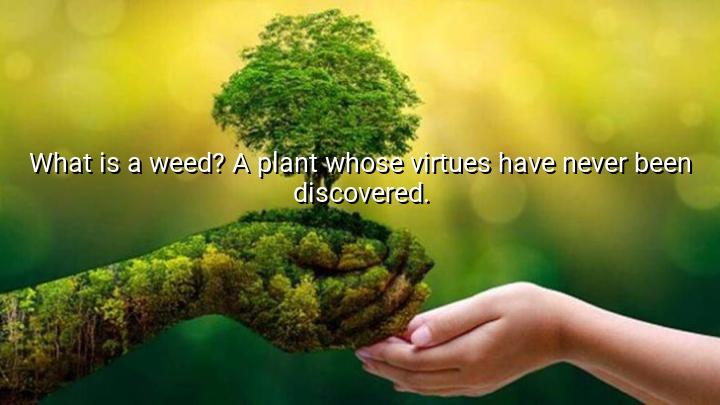




The quote by Ralph Waldo Emerson, "What is a weed? A plant whose virtues have never been discovered," challenges the conventional notion of what defines a weed. Emerson suggests that a weed is simply a plant whose value or use has not yet been recognized or understood. This perspective invites a more open-minded and curious approach to nature, encouraging us to reconsider the way we categorize plants. What might be labeled as a weed could, in fact, possess qualities or benefits that we are yet to appreciate or discover.
Emerson’s statement also reflects his broader philosophy of individuality and potential. Just as plants are often judged by their outward appearance or immediate usefulness, people too can be misunderstood or underappreciated if their true virtues are not recognized. By redefining a weed as simply a plant with undiscovered virtues, Emerson suggests that everything in life has potential waiting to be realized, even if it hasn’t been fully understood yet. This idea encourages us to look beyond labels and surface judgments.
In the context of gardening and nature, Emerson’s quote calls attention to the complex relationship between humans and the environment. It implies that nature is full of hidden value, and our lack of knowledge or perspective may limit our ability to see that value. It also speaks to the idea that human attitudes towards nature can evolve over time, as we discover new uses for plants or learn to appreciate their unique contributions to the ecosystem.
The origin of this quote lies in Emerson’s transcendentalist philosophy, which emphasized the importance of nature as a source of wisdom, growth, and inspiration. Emerson, a prominent American essayist and philosopher, often explored how humans interact with the natural world, encouraging a deep, respectful engagement with the environment. This quote encapsulates his belief in the potential and intrinsic worth of all things, urging us to look beyond conventional judgments and embrace a more thoughtful, open-minded approach to nature.

AAdministratorAdministrator
Welcome, honored guests. Please leave a comment, we will respond soon