

We tend to think of age only in time, but I don't think it has much to do with time at all; there's a whole load of other things. I've met 16-year-olds who are old and 90-year-olds who are young.
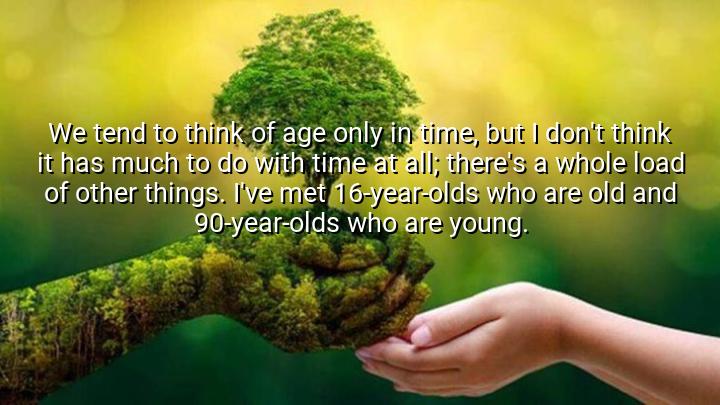




Roger Daltrey’s quote challenges the conventional view of age as merely a measure of time. He suggests that age is not solely defined by the number of years one has lived but is influenced by many other factors. By stating, "there’s a whole load of other things," Daltrey emphasizes that youthfulness or old age can be shaped by energy, mindset, and life experiences, not just the calendar.
Daltrey’s mention of meeting 16-year-olds who feel “old” and 90-year-olds who feel “young” illustrates the idea that age is subjective. This reflects how some young people may exhibit characteristics often associated with aging, such as lack of vitality or a limited perspective, while older individuals may retain a sense of vigor, curiosity, and openness that keeps them feeling younger than their years. His insight challenges the traditional notion that age always aligns with physical or mental condition.
By pointing out these contrasts, Daltrey is suggesting that age is more complex than a simple chronological number. Emotional well-being, mental health, and the way we approach life can have a profound impact on how old or young we feel. The quote encourages a broader understanding of aging, emphasizing that people can defy expectations based on their physical age.
Ultimately, Daltrey’s reflection invites us to reconsider how we view and experience age. It highlights that our sense of age is influenced by many internal and external factors, and that vitality or youthfulness can exist at any stage of life, regardless of how many years we have lived.

NTNhang Trieu
This quote resonates with the idea that age isn't linear but dynamic. I’m curious—how much of our perception of age is shaped by external labels versus internal experience? If society didn’t impose these age-based expectations, would more people live with vitality regardless of their birth year? Maybe the real challenge is to stop letting time dictate our sense of identity.
HAHoang anh
The quote makes me reflect on how we often define age by limitations instead of potential. A 90-year-old who learns, laughs, and explores is somehow 'younger' than someone who’s given up at 25. Could this mean we should treat youthfulness as a discipline—something you practice through curiosity, gratitude, and openness? That feels like a more hopeful way to view growing older.
MAMin Ad
This idea raises an important question: what makes someone feel 'young' or 'old' beyond just years? Is it about hope, resilience, physical health, or maybe how connected they are to change and the world around them? I’ve always felt that playfulness and purpose keep people young. But I wonder, is it possible to cultivate that sense of youth regardless of life circumstances?
QH13 Vo Quang Huy
Daltrey’s quote feels like a direct critique of ageism. We often limit opportunities and expectations based on someone's age without really looking at who they are. Shouldn't we shift our focus from age to energy, attitude, and emotional depth? This could radically change how we think about career paths, creativity, and even relationships. Why don’t we talk more about 'ageless qualities' instead of timelines?
TKpham trung kien
I love this perspective because it challenges the way society categorizes people by age. Why are we so obsessed with milestones—like being 'too old' for something at 40 or 'too young' to understand at 20? Isn’t it more useful to ask how someone sees the world, how open they are to growth, or how much joy they carry? Maybe emotional age is more important than biological age.