

We should burn all libraries and allow to remain only that which everyone knows by heart. A beautiful age of the legend would then begin.
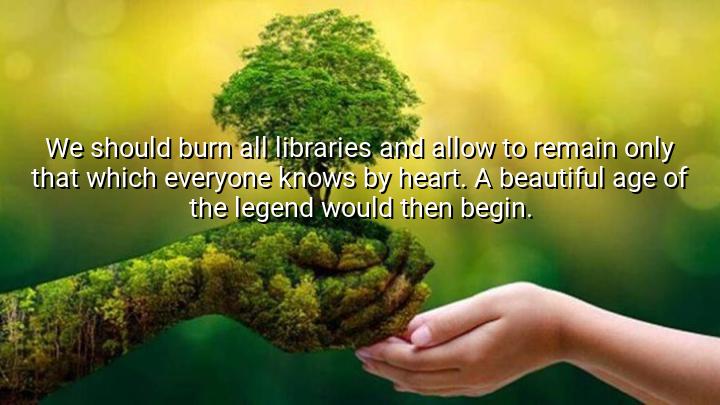




In this provocative quote, Hugo Ball, a German writer and one of the founders of the Dada movement, suggests an extreme idea about knowledge and culture. He proposes that society should "burn all libraries" and retain only the knowledge that people can remember by heart, suggesting that in doing so, we would enter a "beautiful age of the legend." The quote conveys a sense of longing for a time when knowledge and stories were passed down through oral tradition, where legends and myths formed the foundation of culture, rather than written records or books.
Ball’s words criticize the increasing reliance on written knowledge and the institutionalization of learning, which he might have seen as alienating or dehumanizing. By advocating for a world where only what is remembered is preserved, he envisions a return to a more personal, subjective way of knowing—one in which individual memory and shared experience shape culture. The "beautiful age of the legend" he refers to would be a time where stories and wisdom are handed down directly from person to person, much like the traditional storytelling that defined early civilizations before the advent of written language.
The origin of this quote lies in Ball’s involvement with the Dada movement, an avant-garde art movement that rejected conventional standards and values, including those of traditional culture, logic, and reason. Dadaists, including Ball, sought to challenge the societal norms of their time, especially in the aftermath of World War I. This quote can be seen as part of Ball’s larger critique of modernity, where he questions the role of books and institutions in shaping what we consider to be knowledge and truth.
Ultimately, Ball’s quote is a radical commentary on how knowledge is transmitted and the role of memory and storytelling in preserving culture. While his suggestion to burn libraries is clearly exaggerated, it highlights the tension between traditional forms of wisdom and the modern systems that store and control knowledge. The quote encourages us to think about the value of oral history, memory, and how human culture might look if it were rooted in shared experience rather than written texts.

HKPhan Vu Huy Khang
Does this quote express a longing for a pre-modern world, where stories were sacred and shared through lived experience? I feel the tension between romanticism and destruction here. While I get the desire to value what's truly remembered and cherished, the idea of burning libraries evokes horror. Could there be a middle ground—where the archive coexists with legend, and each form of knowledge enriches the other rather than competes?
THPhan Thi Hien
There’s a raw, almost anarchic beauty to this idea. Burn the books, let only the soul's memory decide what survives. But is that too idealistic? As much as I love legends and oral tradition, this concept seems to reject centuries of recorded human progress. Is Ball imagining a utopia of cultural essence—or just rebelling against intellectual institutions and their authority? Either way, it’s a radical and deeply emotional vision.
BTLe Nguyen Bao Tran
This quote makes me reflect on the role of memory and communal storytelling. What would survive if we had to rely only on what people remembered and shared? Would that foster deeper cultural bonds—or would it limit intellectual growth and diversity? It’s such a bold idea, yet I worry that this 'beautiful age of legend' would end up erasing critical knowledge, especially scientific and historical records that aren’t easily reduced to legend.
NLDan Nha Nap Lan
Is this meant as satire or genuine provocation? It sounds like an artistic manifesto—one that challenges our dependence on recorded knowledge. But I can’t help wondering, what happens to complexity, nuance, and dissent when we rely solely on memory? Wouldn’t such a world privilege myths over facts, charisma over truth? It’s a compelling vision, but also one that seems dangerously vulnerable to distortion and loss.
L1Vang Lop 11B4
This quote feels both poetic and terrifying. Is Hugo Ball advocating for a return to oral tradition as a way to purify culture, or is this a critique of how sterile and impersonal knowledge has become? I’m conflicted—on one hand, there’s something romantic about only preserving what’s deeply internalized. But on the other, what about the marginalized voices and histories that might never be memorized? Isn’t this idea inherently exclusionary?