

We may think we live in a digital age. But there are some things technology will never replace.
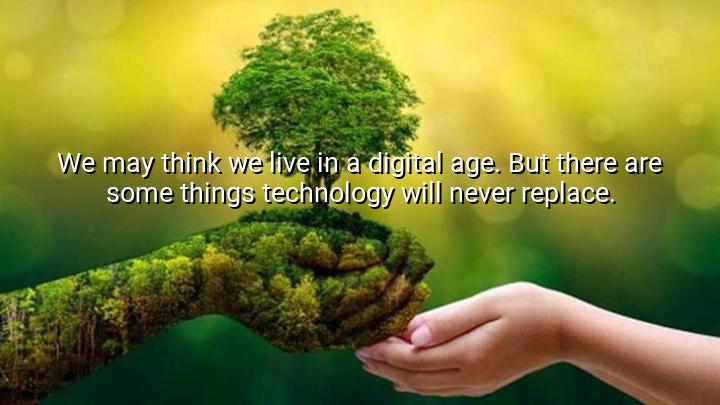




In this quote, Katie Hopkins, a British media personality, reflects on the limits of technology in the modern world. While she acknowledges that we live in a digital age where technology influences almost every aspect of our lives, she argues that there are some fundamental aspects of human experience that technology will never be able to replace. This suggests that, despite the advances in digital tools and automation, certain emotions, connections, and human experiences remain uniquely irreplaceable by machines.
Hopkins' statement emphasizes the idea that while technology continues to evolve and revolutionize how we communicate, work, and live, it cannot replicate or replace essential aspects of human interaction and emotion. These include qualities like empathy, genuine connection, and the subtle nuances of face-to-face communication. Her quote suggests that technology may make life more efficient, but it cannot fully substitute the deep, meaningful experiences that come from human relationships and personal engagement.
The origin of this quote likely comes from Hopkins' observations on the growing dependence on digital technologies in everyday life, particularly in the realms of social media, entertainment, and work. Known for her provocative commentary on current events, Hopkins often critiques the impacts of modern technologies on society and advocates for a balance between the digital and physical worlds. Her words may be a response to concerns over technology’s impact on mental health and the human capacity for authentic connection.
Ultimately, Hopkins’ quote serves as a reminder that despite our increasing reliance on digital tools, there are aspects of the human experience that remain beyond the reach of machines. It encourages us to reflect on the value of human interaction and the need to preserve our ability to connect emotionally and meaningfully with others, even in a rapidly advancing digital world.

THNguyen tran thanh hue
Her words remind me that for all our technological advancements, there's still no app for true human warmth or moral judgment. Yes, AI can write poetry, but can it understand heartbreak? It can analyze voices, but can it truly feel love? Maybe we’re headed toward a hybrid future—part digital, part deeply human. And maybe the real test will be how we maintain authenticity in an increasingly artificial world.
ANAnh Ngoc
This feels like a quiet warning about overdependence on machines. I think of how kids today are growing up with digital everything—books, toys, conversations. Will they grow up lacking some of the sensory, tangible experiences older generations took for granted? Maybe what we need is to be more deliberate about what we keep analog. Not out of fear of tech, but to stay rooted in something physical and real.
THNguyen Thi Thuy Hien
Hopkins’s quote brings up an interesting debate: what do we actually want to protect from technology? For me, it’s the ability to be present—to listen deeply, to hold silence, to feel without a filter. But then again, even those can be mediated now through apps and algorithms. Are we trying to hold onto something already altered? Or is there still a sacred space untouched by screens?
KNNguyen Thi Kim Ngan
It’s a bold statement, and I’m inclined to agree—technology has its limits. But I’m also wary of romanticizing the ‘non-digital’ world too much. Aren’t there things that have actually improved because of tech—like access to education or remote medicine? Maybe the real challenge isn’t about replacement but integration. Can we keep what matters while still evolving with the tools at our disposal?
PNNguyen Phuong Nhi
I find this quote both comforting and curious. There’s reassurance in the idea that not everything is at risk of being replaced by tech. But I’d love to ask: where do we draw the line? We've already digitized relationships, memories, and even parts of our identity. Is the line between replaceable and irreplaceable getting thinner? And if so, how do we preserve what’s truly human?