

We live in the age of entitlement, as opposed to enlightenment.
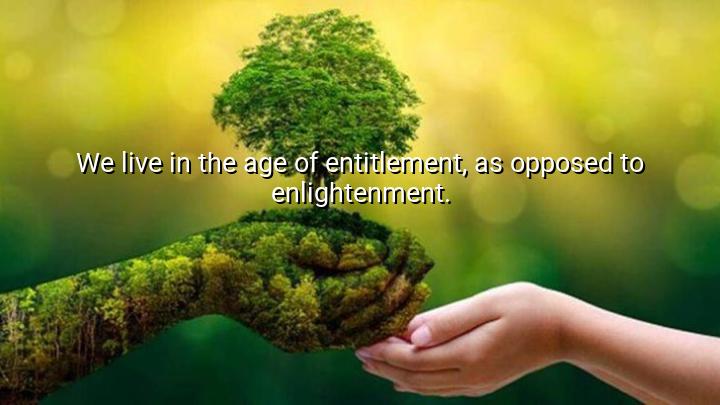




The quote "We live in the age of entitlement, as opposed to enlightenment" by Bill Bailey, a British comedian and musician, critiques modern society's focus on entitlement rather than the pursuit of wisdom and understanding. Bailey contrasts two key concepts: entitlement, which refers to the belief that one deserves privileges or special treatment, and enlightenment, which involves awareness, critical thinking, and a deeper understanding of life and the world. By suggesting that we live in an "age of entitlement," Bailey highlights a cultural shift towards a sense of immediacy and self-interest, where individuals expect things to be handed to them without effort or merit.
Bailey’s remark implies that society today tends to prioritize personal desires and instant gratification over intellectual growth or spiritual development. In the "age of entitlement," people often feel that they deserve more, whether it’s material wealth, recognition, or special treatment, without necessarily working for it or contributing to the greater good. This creates a culture that values privileges over personal responsibility, diminishing the importance of striving for knowledge and self-improvement.
On the other hand, the term "enlightenment" refers to a period in history where people sought intellectual freedom, reason, and a deeper understanding of the world, as seen during the Enlightenment era. Bailey contrasts the pursuit of truth and wisdom with today’s focus on self-entitlement. In this context, the quote suggests that society should shift its focus from selfish desires and expectations to a more collective and thoughtful pursuit of understanding, where individuals are encouraged to think critically and act responsibly.
Ultimately, Bill Bailey’s quote serves as a critique of modern culture, where instant gratification and entitlement have taken precedence over the pursuit of intellectual growth and enlightenment. By calling attention to this shift, Bailey encourages reflection on the importance of enlightenment—not just as an individual pursuit, but as a societal value that leads to deeper, more meaningful engagement with the world.

MAMai Anh
This statement makes me uncomfortable because it seems so accusatory—like a blanket judgment on an entire generation or society. But maybe that discomfort is good. Maybe it challenges us to ask: Am I living with a sense of entitlement or with a hunger for deeper understanding? It’s easy to criticize the culture, but hard to examine our own attitudes. What practical steps can individuals take to shift their mindset toward enlightenment?
HYBui Le Hai Yen
Bailey’s quote makes me question how we raise and educate people today. Are we instilling values like patience, resilience, and intellectual curiosity? Or are we fostering a belief that everything should come easily? It’s a provocative idea—maybe our systems (education, media, politics) reward entitlement more than critical thinking. How can we design institutions that encourage genuine enlightenment instead of feeding into this mindset of 'I deserve it'?
TABui Pham Thuy Anh
I find this quote a bit cynical, though it makes a valid point. It paints a stark contrast between two big societal forces. But is entitlement really a new phenomenon, or just more visible now? And what exactly does 'enlightenment' mean in today’s world—philosophical thinking, empathy, or scientific literacy? I'd love to see more clarity on what we’re lacking, not just what we’ve supposedly lost.
MHhoang manh hung
I'm torn about this statement. On one hand, it does feel like entitlement is everywhere—social media, politics, even customer service interactions. But on the other hand, we have access to more knowledge and critical dialogue than ever before. Could it be that enlightenment hasn’t disappeared, but is just harder to recognize in the flood of opinions and self-interest? What would it take to shift the cultural focus back toward wisdom and humility?
TTVo Thi Thanh Thao
This quote hits hard, especially when I think about how often people expect instant gratification nowadays. From same-day deliveries to viral fame, there’s a strong sense of 'deserve' without the grind. But I wonder—have we really moved away from enlightenment entirely, or is it just harder to notice in the digital noise? Are there still pockets of deep thinking and learning thriving beneath the surface of our culture?