

We live in such an age of chatter and distraction. Everything is a challenge for the ears and eyes.
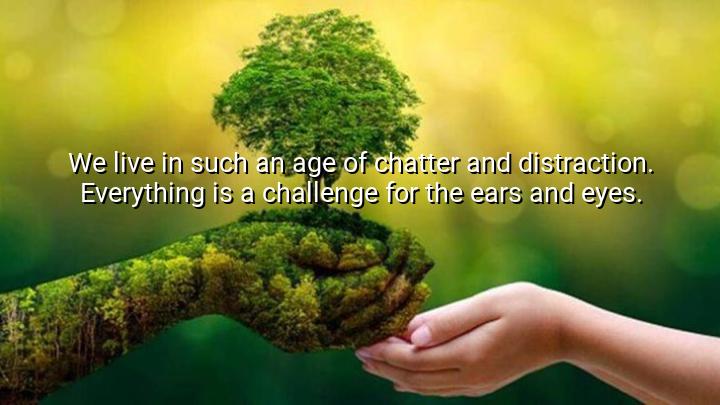




The quote, "We live in such an age of chatter and distraction. Everything is a challenge for the ears and eyes," comes from Rebecca Pidgeon, an American actress and singer. In this statement, Pidgeon reflects on the overwhelming nature of modern life, where constant noise, distractions, and the bombardment of stimuli make it increasingly difficult to focus and engage meaningfully with the world around us. She suggests that in today's society, both the ears and eyes are constantly challenged by the flood of information and sensory input.
The phrase "age of chatter and distraction" points to the modern phenomenon where people are continuously surrounded by external noise—from social media, news, advertisements, and even the constant hum of digital communication. This overabundance of information can be overwhelming, leaving little space for deep thinking, contemplation, or meaningful conversation. Pidgeon implies that the constant distraction prevents individuals from truly being present in the moment or connecting with their inner thoughts.
By saying that "everything is a challenge for the ears and eyes," Pidgeon emphasizes the sensory overload of the modern age. With so much competing for our attention, our senses are stretched thin, making it harder to focus on the things that truly matter. The challenge of filtering out unnecessary distractions becomes a daily struggle for individuals seeking clarity or deeper understanding.
Ultimately, Pidgeon’s quote serves as a reflection on the distracting nature of contemporary life and the impact it has on our ability to fully engage with the world around us. It highlights the importance of slowing down, creating moments of quiet, and finding ways to disconnect from the constant noise in order to regain focus and connection with ourselves and others.

TTAn Nguyen Thai Thu
I feel this quote highlights a growing problem—our sensory environment is so chaotic that it’s hard to prioritize what truly matters. Sometimes I wonder if this constant challenge to our ears and eyes leads to decision fatigue or emotional exhaustion. What role do you think mindfulness or digital detoxes can play in helping us regain control over our attention?
DRDuyen Rom
Reading this makes me think about how much we take for granted the power of stillness. In an age filled with endless chatter, it seems like being alone with our thoughts is a revolutionary act. But I’m curious—does this barrage of stimuli also create opportunities for connection and creativity, or is it mostly destructive? Can we find balance between engagement and retreat?
HMVuong Hai My
This quote feels like a gentle warning about the sensory overload we live with. It’s interesting to consider how ‘everything being a challenge for the ears and eyes’ impacts our mental health and creativity. I wonder if this noise drowns out the inner voice or intuition that guides us. How important is it to carve out deliberate silence or solitude, and is that even possible in our hyperconnected age?
TNLe Nguyen Thuy Nhi
Rebecca Pidgeon’s words capture a real modern dilemma. I wonder if this constant stimulation has made us less patient or more superficial in our interactions. Are we truly absorbing anything, or just skimming the surface? It’s exhausting to think about how many demands there are on our senses daily. What strategies do you think work best to manage this bombardment and find mental clarity?
MDManh Duc
This quote really resonates with me, especially in today’s digital world where constant notifications and noise bombard us every second. It feels like our brains are always on overload, struggling to filter the endless chatter. Do you think this ‘age of distraction’ is eroding our ability to focus deeply? How can we reclaim moments of quiet and meaningful attention in such a noisy environment?