

We humans lack imagination, to the point of not even knowing what tomorrow's important things will look like.
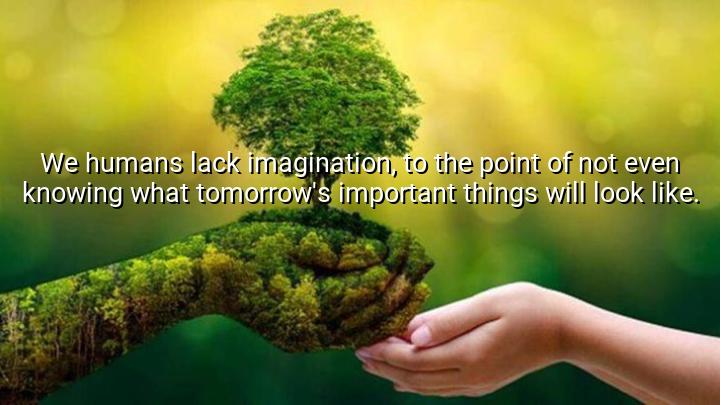




The quote "We humans lack imagination, to the point of not even knowing what tomorrow's important things will look like" by Nassim Nicholas Taleb reflects on the limitations of human foresight and our inability to predict significant future events or trends. Taleb, a philosopher and author known for his work on uncertainty and risk, argues that despite our sophisticated tools, we are often poor at imagining the future. We fail to foresee the transformative events or shifts that could shape the world, which suggests a fundamental lack of imagination in how we plan and think about what lies ahead.
Taleb’s statement is a critique of the overconfidence in predicting the future based on past trends, which often leads us to underestimate unpredictable and disruptive changes. He points out that even though we constantly try to anticipate and control the future, we remain fundamentally blind to the unknown and to the elements that might radically reshape the world. This lack of imagination keeps us from preparing adequately for what might be the most important developments—those we cannot foresee.
The origin of this quote lies in Taleb's broader philosophy of antifragility and his book The Black Swan, where he explores how rare and unpredictable events have a massive impact on our world. Taleb argues that rather than relying on rigid predictions or models, we should embrace uncertainty and learn to adapt to the unexpected. In this context, his statement about imagination speaks to the inherent unpredictability of the future and the limits of human foresight in the face of complexity and randomness.
Ultimately, Taleb’s quote underscores the idea that our inability to truly imagine the future can lead to significant blind spots in decision-making. While we may attempt to predict what will be important tomorrow, the reality is that many of the key events will be beyond our comprehension or ability to anticipate. This highlights the importance of fostering a mindset that is flexible, adaptable, and prepared for the unexpected, rather than overly confident in our ability to foresee the future.

AAdministratorAdministrator
Welcome, honored guests. Please leave a comment, we will respond soon