

I'm in favour of religion as a tamer of arrogance. For a Greek Orthodox, the idea of God as creator outside the human is not God in God's terms. My God isn't the God of George Bush.
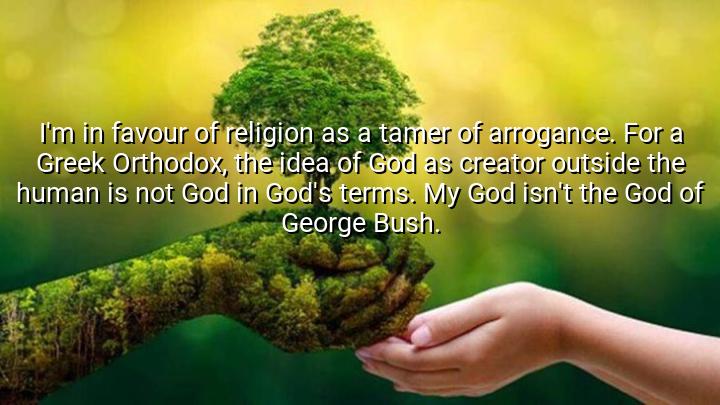




The quote "I'm in favour of religion as a tamer of arrogance. For a Greek Orthodox, the idea of God as creator outside the human is not God in God's terms. My God isn't the God of George Bush" by Nassim Nicholas Taleb explores the role of religion in modulating arrogance and human behavior. Taleb suggests that religion can serve as a humbling force, helping individuals to confront their own limitations and recognize the vastness of the world beyond their personal experiences. In this context, religion functions as a reminder that human beings are not the center of existence, and that true spirituality demands humility rather than pride.
Taleb, a renowned philosopher and mathematician, known for his writings on uncertainty and risk, offers a critique of certain religious views that place God in a distant or detached role as the creator of the universe. From his perspective as a Greek Orthodox, he challenges the idea of God being separate or external to humanity. For Taleb, true spirituality transcends the idea of a distant creator and instead sees God as deeply intertwined with the human experience—more personal and experiential than doctrinal or political. In contrast, he contrasts his understanding of God with the more politicized view held by figures like George Bush.
The origin of the quote can be linked to Taleb’s broader critique of human arrogance and self-centeredness. Taleb’s work often centers around the idea of uncertainty and how humans fail to fully grasp the complexity and randomness of life. He sees religion as an antidote to this arrogance—offering a framework that encourages humility and an acknowledgment of higher forces. His critique of political figures like George Bush highlights his belief that using religion for political gain distorts its true purpose, which, for Taleb, is about recognizing divinity within ourselves and the world, not as a tool for control.
Ultimately, this quote reflects Taleb’s philosophical view that religion should act as a force for self-reflection and humility, rather than a vehicle for power or domination. He challenges the conventional, external understanding of God as a creator who is separate from human existence, urging instead for a more integrated and personal view of spirituality. Taleb’s perspective invites a spirituality that is deeply rooted in human experience, humility, and the recognition of our limitations in a vast and unpredictable world.

AAdministratorAdministrator
Welcome, honored guests. Please leave a comment, we will respond soon