

The next time you experience a blackout, take some solace by looking at the sky. You will not recognize it.
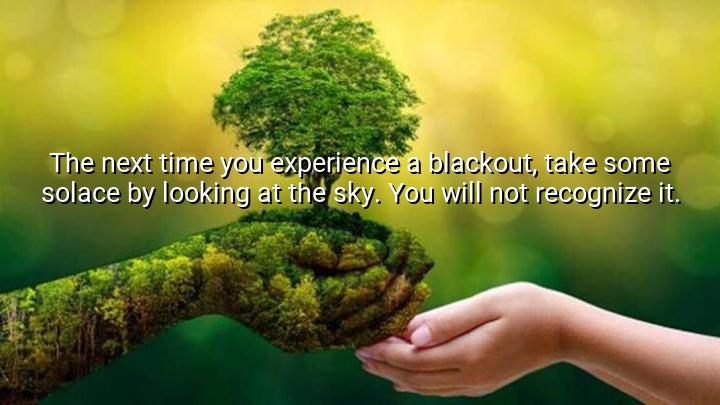




The quote "The next time you experience a blackout, take some solace by looking at the sky. You will not recognize it." by Nassim Nicholas Taleb offers a profound reflection on perception, change, and the unpredictable nature of our world. Taleb, a scholar and author known for his work on uncertainty and randomness—particularly in his book The Black Swan—uses this metaphor to illustrate how sudden disruptions can reveal new realities that we hadn’t noticed or understood before.
By referring to a blackout, Taleb points to moments when familiar systems fail—whether literally, as in a power outage, or metaphorically, as in unexpected crises. During these times, our usual routines and perceptions are interrupted. The instruction to look at the sky suggests turning our attention outward and embracing the unfamiliar. The sky, once taken for granted, appears changed or unrecognizable, symbolizing how disruptions can alter our understanding of the world around us.
This quote encourages us to find solace in uncertainty and transformation. Instead of fearing the unknown, Taleb invites us to see such moments as opportunities to rediscover and re-evaluate our environment and ourselves. The “unrecognizable” sky serves as a reminder that change, though unsettling, can expand our perspective and open us up to new possibilities.
Ultimately, Taleb’s words embody his broader philosophy about the importance of embracing randomness and uncertainty. They remind us that moments of chaos or disruption can be moments of insight and growth, encouraging a mindset of curiosity, adaptability, and acceptance in an unpredictable world.

AAdministratorAdministrator
Welcome, honored guests. Please leave a comment, we will respond soon