

We don't appreciate what we have until it's gone. Freedom is like that. It's like air. When you have it, you don't notice it.
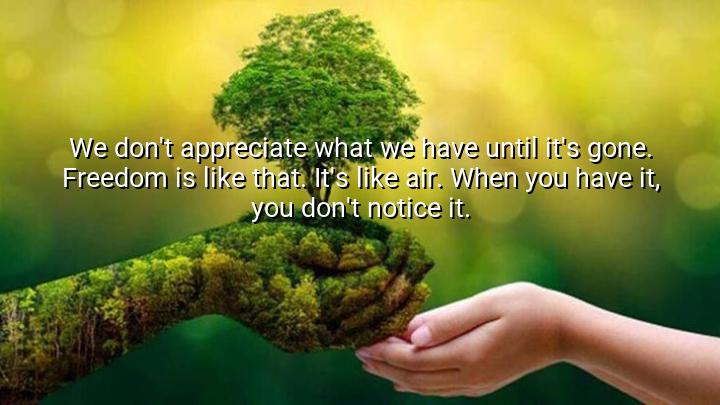




The quote by Boris Yeltsin reflects on the often unnoticed nature of freedom until it is taken away. Yeltsin compares freedom to air, suggesting that, much like the air we breathe, it is an essential and constant part of our lives that we tend to overlook when it is readily available. The quote emphasizes that freedom is often only truly appreciated once it is lost, and people tend to take it for granted when they have it. This observation speaks to the human tendency to overlook the privileges we enjoy until circumstances change, and those privileges are no longer guaranteed.
Yeltsin’s comparison of freedom to air is powerful because it underscores how vital and omnipresent it is in a person's life, yet how easily we can fail to acknowledge its significance. When we are not under threat or oppression, freedom seems like an assumed part of our daily existence, much like the air we breathe. Only in times of restriction or loss do we recognize how essential it is to our well-being and our sense of self.
The origin of this quote comes from Boris Yeltsin, the first President of Russia, who led the country during a tumultuous period as the Soviet Union collapsed and democracy was re-established. Yeltsin, who experienced firsthand the shift from a totalitarian regime to a more democratic society, was keenly aware of the fragile nature of freedom. His words reflect both his personal experiences and his broader understanding of the political and historical context in which freedom can be threatened.
Ultimately, Yeltsin’s quote reminds us to be mindful of the freedoms we have and to appreciate them while they are available. It urges individuals to recognize that freedom is a precious and often invisible right that we only truly understand when it is jeopardized or lost. His words serve as a call to cherish and protect the freedoms that we often take for granted, ensuring that they are not lost to future generations.

AAdministratorAdministrator
Welcome, honored guests. Please leave a comment, we will respond soon