

We aren't in an information age, we are in an entertainment age.
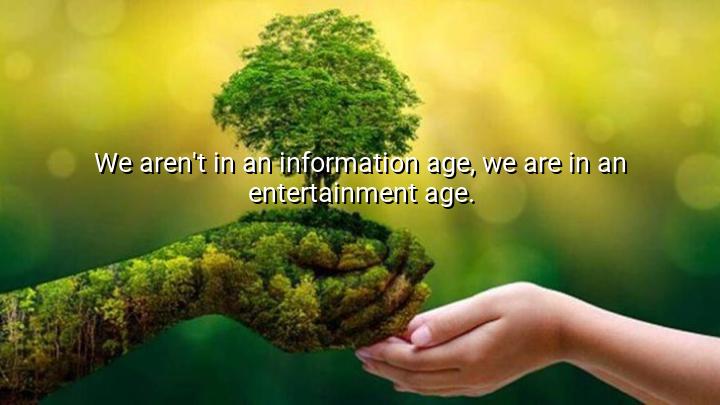




In this quote, Tony Robbins critiques the common perception that we are living in an information age. While many believe that the current era is defined by the rapid flow of information, Robbins argues that it is actually an entertainment age. He suggests that, in modern society, the focus has shifted from purely acquiring and sharing knowledge to consuming content that is primarily designed to entertain and capture our attention. This shift indicates a change in priorities, where entertainment often takes precedence over the pursuit of meaningful information.
Robbins’ statement reflects the growing dominance of media, particularly in the form of television, social media, and online content, which are often geared more towards engagement and entertainment rather than providing factual or educational material. As a result, people are more likely to consume content that provides instant gratification and enjoyment, rather than information that requires critical thinking or offers lasting value. This has led to a situation where information can be diluted or overshadowed by sensationalized entertainment.
The quote also touches on the way technology has transformed the way we access and process information. While the internet was initially hailed as a tool for spreading knowledge, it has increasingly become a platform where content is tailored to grab attention and keep users engaged. Robbins suggests that this trend has reshaped how we view knowledge and learning, often reducing them to bite-sized, entertaining pieces rather than deep, thought-provoking content.
Ultimately, Tony Robbins’s quote serves as a reminder to evaluate how we consume information in today’s digital world. He challenges us to reconsider whether we are truly living in an age of knowledge, or if we have become more focused on the fleeting pleasures of entertainment, which can divert our attention away from more substantial intellectual pursuits. The quote invites reflection on how we balance entertainment with meaningful learning in a world constantly filled with distractions.

DNHa Dao Ngoc
Do you think we’ve reached a point where being entertaining is more important than being accurate? With influencers, media outlets, and even politicians focusing more on virality than veracity, it's a scary thought. How do we reclaim the value of truth and substance in a world where style often overshadows substance?
SLSon Ly
This quote brings up an internal conflict I often feel—when I want to learn something meaningful but get sucked into endless scrolls of humorous or emotional content. Is our attention span being trained to reject anything that requires effort or patience? What does this mean for our future intellectual development and societal progress?
PLPhuong Linh
Robbins makes a powerful statement, but I think it's a bit reductive. We still have access to more high-quality, factual information than ever before. The issue is more about how it's packaged and consumed. Are people choosing entertainment over information, or is it that the information now has to compete with a constant stream of distraction?
UGUser Google
I wonder what this means for younger generations growing up with TikTok, YouTube, and streaming news. Are they equipped to filter truth from performance? If entertainment dominates, does it mean we’re losing the skills needed to analyze, question, and reason? Should we be more worried about how this shift influences politics, education, and societal priorities in the long run?
AFADC Flash
Interesting take from Tony Robbins. I think he’s pointing to a real shift in how we consume content. But is that necessarily a bad thing? Entertainment can be a powerful tool for education and communication. Think of documentaries or edutainment platforms. Maybe the question isn’t whether we’re in an entertainment age, but whether we’re using that entertainment responsibly and with intention.