

We are sinful not only because we have eaten of the Tree of Knowledge, but also because we have not yet eaten of the Tree of Life. The state in which we are is sinful, irrespective of guilt.
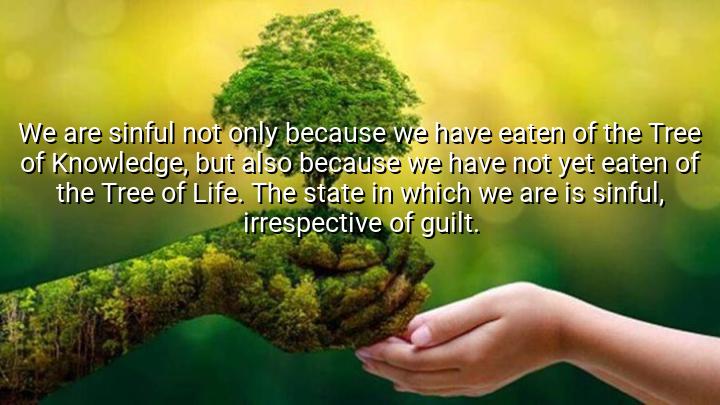




The quote by Franz Kafka, “We are sinful not only because we have eaten of the Tree of Knowledge, but also because we have not yet eaten of the Tree of Life. The state in which we are is sinful, irrespective of guilt,” explores the existential and spiritual dimensions of human existence. Kafka suggests that human sinfulness is inherent in our condition, stemming not only from our pursuit of knowledge but also from our lack of full engagement with life, vitality, and spiritual fulfillment represented by the Tree of Life. This implies that sin is more than moral failing—it is an existential state.
Kafka, a German-speaking writer of early 20th-century Prague, often examined themes of alienation, guilt, and the human struggle to find meaning. In this quote, he reflects on the tension between intellectual curiosity and the broader experience of living fully. While humans seek knowledge, there remains a gap in embracing life itself, and this incompleteness contributes to a sense of inherent sinfulness or limitation.
The origin of this quote lies in Kafka’s philosophical and literary exploration of human existence and moral complexity. Drawing from biblical symbolism, he references the Tree of Knowledge and the Tree of Life to frame the human condition in terms of intellectual pursuit versus experiential and spiritual engagement. Kafka emphasizes that guilt alone does not define sin; rather, it is the condition of being human, caught between knowledge and the full embrace of life, that constitutes sinfulness.
Ultimately, Kafka’s insight reminds us that human sinfulness is not only about moral transgression but about the limitations and incompleteness of our existence. True fulfillment requires more than intellectual knowledge; it requires connection to life, spirit, and vitality. The quote encourages reflection on the balance between learning, living, and the search for deeper meaning.

AAdministratorAdministrator
Welcome, honored guests. Please leave a comment, we will respond soon