

How pathetically scanty my self-knowledge is compared with, say, my knowledge of my room. There is no such thing as observation of the inner world, as there is of the outer world.
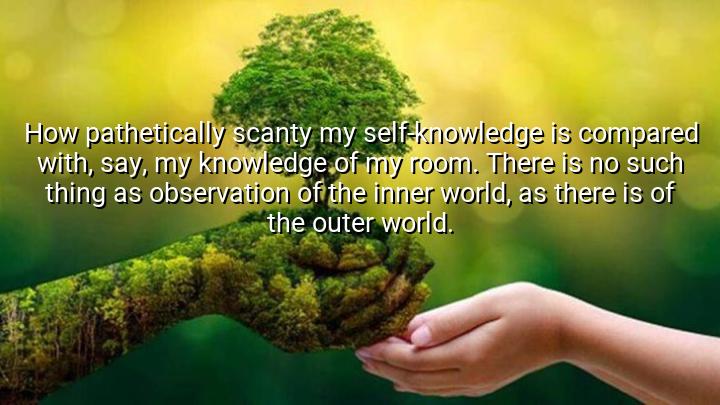




The quote by Franz Kafka reflects on the limitations of self-knowledge compared to our understanding of the external world. Kafka acknowledges that while we can easily observe and understand tangible, physical environments—like his knowledge of his room—our insight into our own inner world remains elusive. This contrast highlights the complexity and mystery of human consciousness and emotion.
By stating that “there is no such thing as observation of the inner world,” Kafka emphasizes the inherent difficulty of introspection. Unlike the outer world, which can be seen, measured, and analyzed, the inner world—comprising thoughts, feelings, and motivations—cannot be directly observed, making self-understanding a challenging and often incomplete endeavor.
The origin of this quote comes from Kafka’s work as a writer and thinker, whose literature frequently explores themes of alienation, identity, and the human psyche. Kafka’s reflections often delve into the tension between external reality and internal experience, illustrating the profound difficulties of truly knowing oneself. His introspective perspective underscores the philosophical and psychological dimensions of human life.
In essence, the quote underscores the disparity between knowledge of the outer world and the inner self. Kafka invites reflection on the limitations of self-awareness, suggesting that while we may navigate and understand our physical surroundings with ease, achieving true insight into our own nature is far more complex and uncertain.

AAdministratorAdministrator
Welcome, honored guests. Please leave a comment, we will respond soon