

We are approaching a new age of synthesis. Knowledge cannot be merely a degree or a skill... it demands a broader vision, capabilities in critical thinking and logical deduction without which we cannot have constructive progress.
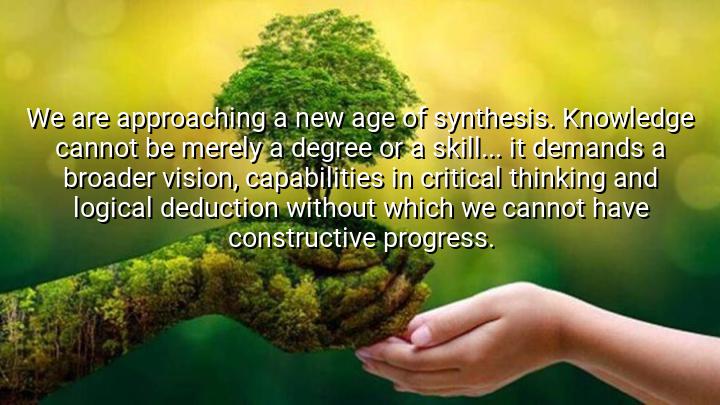




In this quote, Li Ka-shing emphasizes the importance of a new age of synthesis, where the integration of diverse fields of knowledge becomes crucial. He argues that knowledge should not be limited to just acquiring a degree or mastering a specific skill. Instead, it requires a more expansive and interconnected approach that combines various disciplines and perspectives. This broader vision is necessary for addressing complex challenges and fostering innovative solutions.
Li Ka-shing stresses the importance of critical thinking and logical deduction, which are essential tools for navigating the complexities of modern life. Without these capabilities, progress would be hindered, as they are vital for making informed decisions and solving problems effectively. The ability to think critically and deduce logically allows individuals to not only process information but also apply it in meaningful and constructive ways.
The quote reflects a shift in how we perceive education and progress. Li Ka-shing highlights that in order to drive true advancement, we need more than just technical expertise; we need individuals who can synthesize knowledge from various fields and approach problems from multiple angles. This approach, according to him, will lead to constructive progress that can propel society forward.
Overall, Li Ka-shing calls for a redefinition of how we approach learning and problem-solving in the modern world. He encourages a move away from traditional, siloed methods of education and towards an era where interdisciplinary thinking and the ability to integrate knowledge are key drivers of progress.

TNThao Nguyen
Reading this makes me think about the disconnect between formal education and real-world problem solving. So many graduates leave school with impressive degrees but lack the ability to adapt, integrate knowledge, or think outside the box. If synthesis and critical reasoning are vital, then how do we shift from knowledge-as-accumulation to knowledge-as-application? That transition seems urgent if we hope to make meaningful progress.
TMVo Thi Tra My
I find this quote deeply motivating, especially the emphasis on logical deduction and vision. It suggests a kind of intellectual maturity that goes beyond technical skills. But is this broader vision something that can be taught, or is it something that must be cultivated through diverse life experiences? And if it is the latter, are we giving people enough space and opportunity to explore and grow in that way?
TDThuy Doan
This idea makes me reflect on how often we confuse information with wisdom. In the digital era, anyone can gain access to facts, but that doesn’t mean they can analyze or apply them constructively. What does it actually take to develop real critical thinking today? Are schools and workplaces doing enough to promote this? Or are we still rewarding surface-level skills over deeper intellectual engagement?
BDGia Binh Dinh
Li Ka-shing raises a powerful point. We're constantly told to specialize, to focus on one skill or field, but what happens to our ability to see the bigger picture? Is modern society preparing people for this ‘broader vision’ he mentions, or are we still stuck in narrow silos of expertise? I wonder if interdisciplinary education and collaboration are the keys to constructive progress in this synthesis age.
VHCao Thi Viet Hong
This quote really strikes a chord, especially in today's world where information is abundant but deep understanding seems rare. I agree that knowledge isn’t just about acquiring credentials—it’s about cultivating the ability to think clearly and act wisely. But how do we redesign our education systems to foster synthesis, critical thinking, and logic instead of just rewarding memorization and test scores? That seems like a massive shift in philosophy and practice.