

To exist is to change, to change is to mature, to mature is to go on creating oneself endlessly.
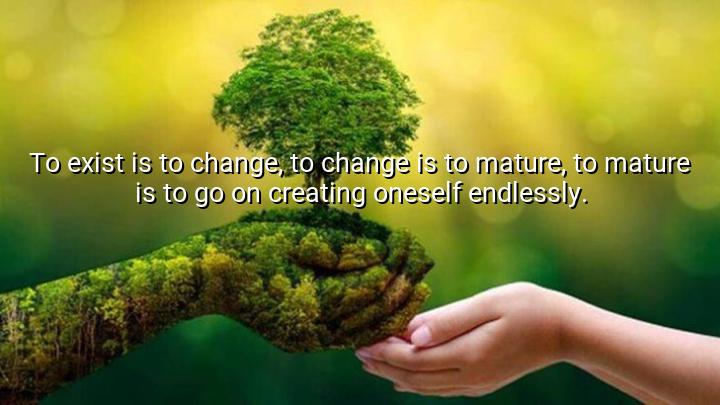




Henri Bergson’s quote, “To exist is to change, to change is to mature, to mature is to go on creating oneself endlessly,” expresses a profound philosophy of growth, identity, and transformation. At its core, the quote suggests that existence is not static but inherently dynamic—to simply be alive is to be in a constant state of change. Bergson presents change not as an occasional event, but as the very essence of life itself.
By linking change to maturity, Bergson implies that personal development comes from embracing life's shifts and uncertainties. As we evolve, we gain deeper self-awareness, wisdom, and emotional depth. Maturing, in this sense, is not merely aging or accumulating experiences, but actively engaging with the process of transformation and learning from it.
The final part of the quote, “to go on creating oneself endlessly,” encapsulates Bergson’s belief in the fluidity of identity. He argues that we are not fixed beings but are always in the process of becoming. This continual self-creation reflects a commitment to inner growth, imagination, and adaptability—qualities that allow us to navigate an ever-changing world with intention and creativity.
The origin of this quote lies in Bergson’s broader philosophical work, which often explored the nature of time, consciousness, and evolution. As a French philosopher and Nobel laureate in literature, Bergson challenged rigid, mechanistic views of reality. He proposed that true understanding of life comes through intuition and movement, rather than logic alone. This quote perfectly encapsulates his belief that human life is a constant unfolding—a creative journey without a final, fixed endpoint.

AAdministratorAdministrator
Welcome, honored guests. Please leave a comment, we will respond soon