

Thousands of years and many civilizations have defined a marriage as the union between one man and one woman. With few exceptions, those civilizations that did not follow that perished.
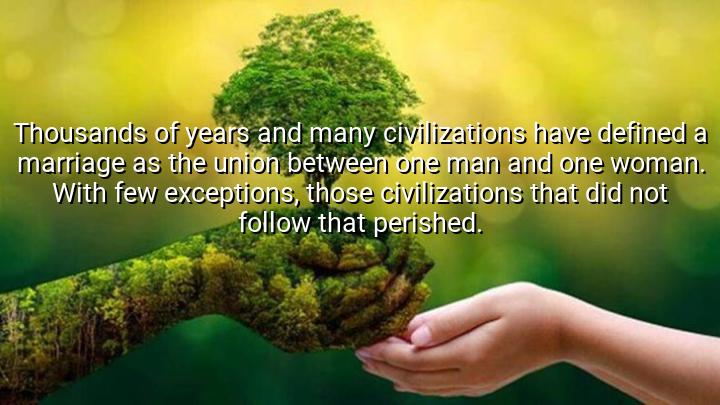




The quote by Randy Neugebauer, a former U.S. Congressman from Texas, reflects a conservative viewpoint on the institution of marriage. Neugebauer frames marriage as a historically consistent union between one man and one woman, pointing to its long-standing role across civilizations over thousands of years. By invoking history, he suggests that traditional definitions of marriage are not merely cultural preferences but essential building blocks of stable societies.
The origin of this quote comes from the broader political and cultural debates in the United States over same-sex marriage, particularly during the early 2000s and 2010s when legal recognition of marriage equality was hotly contested. Neugebauer, aligned with socially conservative values, used historical and moral arguments to oppose the redefinition of marriage to include same-sex couples. His reference to civilizations "perishing" was meant to emphasize his belief that altering the traditional foundation of marriage could lead to societal decline.
The meaning behind the statement lies in its defense of traditional marriage as a stabilizing institution that safeguards moral and social order. Neugebauer implies that civilizations prosper when they adhere to this model and weaken or collapse when they stray from it. By framing his opposition in historical terms, he attempts to portray his stance as not only political but rooted in the lessons of history.
Ultimately, Neugebauer’s quote illustrates a key rhetorical strategy used by opponents of marriage equality—appealing to tradition and historical continuity. However, it also sparked debate, as critics argue that history includes many different forms of unions and that linking societal collapse to deviations from heterosexual marriage oversimplifies complex social dynamics. The statement reflects the clash between traditionalist perspectives and evolving views of equality and civil rights in modern society.

AAdministratorAdministrator
Welcome, honored guests. Please leave a comment, we will respond soon