

Though every legal task demands this skill, it is especially important in the effort to frame public policy in a way that is properly responsive to human needs and predicaments. The question is always: How will the general rule work in practice?
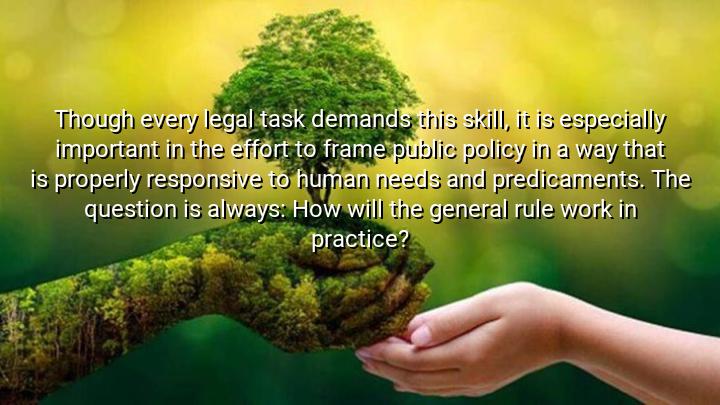




Elliot Richardson’s quote emphasizes the importance of practicality and human-centered thinking in the realm of public policy. He argues that every legal task requires a fundamental skill—the ability to think about how laws, rules, and policies will work in real-world situations, especially in relation to human needs and predicaments. Richardson is suggesting that policymakers and legal experts must constantly consider not just the theory behind laws, but also their practical implications and impact on the lives of ordinary people.
The key phrase in the quote is: "How will the general rule work in practice?" Richardson is highlighting that a legal rule or public policy may look good on paper, but its true value comes from how it operates when applied to actual situations. This reflects a concern for the effectiveness of laws in addressing the real challenges that people face, rather than merely adhering to theoretical principles or abstract ideals. For Richardson, laws should be tested not just by their intentions but by their outcomes and their ability to meet the practical needs of society.
Richardson’s quote draws attention to the role of lawyers, judges, and policymakers in shaping public policy that addresses human dilemmas. His viewpoint reflects his broader legal philosophy, where the focus is on justice and human welfare rather than rigid legal formalism. He argues that in crafting policy, one must be mindful of how individuals experience the legal system, especially those who are most vulnerable or disadvantaged.
The origin of this quote comes from Richardson’s extensive experience in public service, including his roles as U.S. Attorney General, Secretary of Defense, and Secretary of Health, Education, and Welfare. Throughout his career, Richardson was deeply involved in efforts to reform laws and public policy to be more responsive to the needs of citizens. His words emphasize the importance of pragmatism in the legal profession, particularly when dealing with social issues and public welfare.

AAdministratorAdministrator
Welcome, honored guests. Please leave a comment, we will respond soon