

Those who love deeply never grow old; they may die of old age, but they die young.
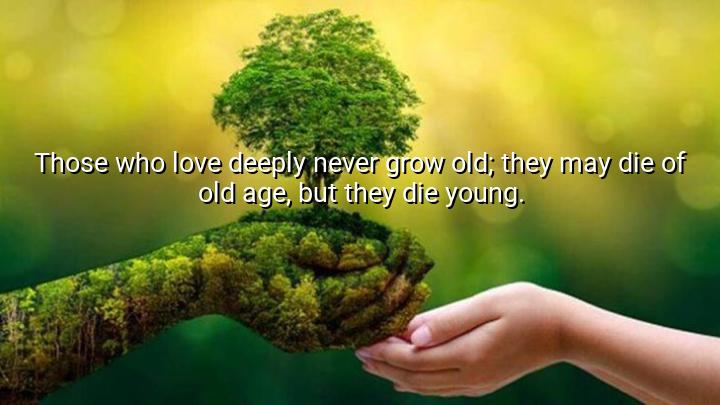




In this profound quote, Dorothy Canfield Fisher suggests that the act of loving deeply has the power to keep one feeling young, regardless of their physical age. She implies that love transcends the limitations of the body and time, offering a kind of vitality and energy that prevents a person from truly growing old. Love, in this sense, keeps the spirit alive and passionate, which contrasts with the decline that often accompanies aging.
Fisher’s words reflect a deep understanding of the human experience and the ways in which emotional connections can provide meaning and purpose throughout life. When we love deeply, we are often filled with a sense of joy, purpose, and fulfillment, which can rejuvenate us even as our bodies change. The phrase "they may die of old age, but they die young" underscores the idea that the essence of the person remains youthful, untouched by the passage of time, even if their body eventually succumbs to age.
The quote also highlights the difference between physical aging and emotional vitality. While our bodies may deteriorate with time, the heart and soul, fueled by deep love and connection, retain their youthful energy. Fisher seems to suggest that it is not years that define us, but our ability to remain emotionally engaged and connected to others. A person who loves deeply continues to experience life with the same intensity and passion as they did when they were young.
Ultimately, Fisher’s quote is a celebration of the enduring power of love, portraying it as a force that can keep a person feeling alive, no matter how many years pass. It encourages us to nurture our emotional connections, as they are key to maintaining the youthful spirit and vigor that make life rich and meaningful, regardless of the inevitable march of time.

LPLinh Phan
This makes me wonder how we define being 'young'. Is it about attitude, emotional openness, or simply avoiding cynicism? If love helps preserve that, then it’s a powerful tool for aging gracefully. But is love alone enough? What about self-love, or love for life itself? It seems to me that the quote invites a broader interpretation of love—beyond just romance—and challenges us to stay emotionally engaged throughout life.
BBBe Bu
I really like the hopeful tone in this quote. It almost implies that the soul has its own age, independent of the body. But is that really true? Could someone bitter in love age faster, emotionally speaking? I’d love to explore the psychological science behind this—does deep love and connection contribute to slower mental or emotional decline? Or is this more of a philosophical or metaphorical truth rather than a literal one?
FFernny
I'm a little torn on this quote. On one hand, it’s a touching sentiment that makes me think emotional richness can preserve a sense of vitality. On the other hand, isn’t this dismissing the very real struggles of aging—illness, loss, physical limitations? Love might help us cope, but does it really keep us 'young'? Or is this more about how others remember us rather than how we actually experience aging ourselves?
SHSon Hoang
This quote makes me reflect on my grandparents. They were in their 80s, but they always had this spark in their eyes, especially around each other. Is love what kept them feeling 'young'? I think there’s something to be said for the energy that comes from connection. But what about people who live alone or have lost loved ones—can they still keep that youthful essence somehow, or is it inevitably lost with solitude?
UBUyen Bui
I find this quote incredibly beautiful and uplifting. It suggests that the vitality of the heart can transcend physical age. But I wonder, does love really have that much power to preserve our spirit? Or is this more poetic than practical? I'd love to hear real-life examples where love gave someone a youthful outlook well into old age. Can emotional depth truly defy the wear of time, or is that romantic idealism?