

This is the problem with modern-day feminism. It used to be about equality. Now, it's about bashing men, asking for free stuff, and tearing down other women for refusing to play victim to the trumped-up, B.S. 'War on Women.'
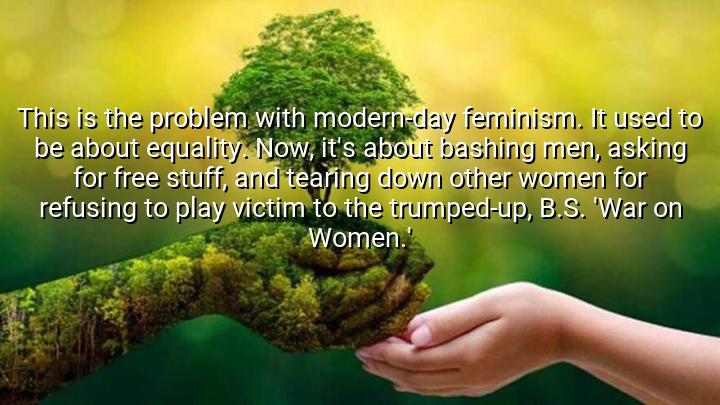




Tomi Lahren’s quote critiques what she sees as a shift in the goals of modern-day feminism, arguing that it has moved away from its original mission of equality and has become more about attacking men, demanding free stuff, and tearing down other women who do not subscribe to her view of feminism. Lahren’s perspective suggests that the feminist movement has evolved into something that, in her view, focuses more on division, rather than the empowerment and equal rights that were its foundational aims. She is particularly critical of what she perceives as a focus on victimhood and a "War on Women" narrative that she considers exaggerated or trumped-up.
The quote also reflects a broader political and cultural disagreement on the direction of feminism. Lahren expresses frustration with the way some factions of the movement have become associated with entitlement and grievance politics, where the focus, according to her, has shifted from genuine social change to a more divisive and adversarial stance. By framing the movement as being about "bashing men" and tearing down women, she criticizes those who she feels engage in identity politics, especially within feminist discourse.
Lahren’s use of the phrase "War on Women" is a direct critique of what she sees as an overblown narrative used to rally political support. She implies that the issue of women’s rights has been hijacked by political agendas that exaggerate problems rather than focus on genuine, actionable issues related to gender equality. For Lahren, feminism should be more about creating a level playing field, not dividing the sexes or framing women as perpetual victims.
Ultimately, Lahren’s quote illustrates her belief that feminism in its current form has lost sight of its core values of equality and empowerment. She calls for a return to a more pragmatic, unifying feminism that focuses on actual progress rather than polarizing narratives. This perspective is part of a larger debate about how feminism should evolve and how it should address the challenges women face in contemporary society.

AAdministratorAdministrator
Welcome, honored guests. Please leave a comment, we will respond soon