

This is the first age that's ever paid much attention to the future, which is a little ironic since we may not have one.
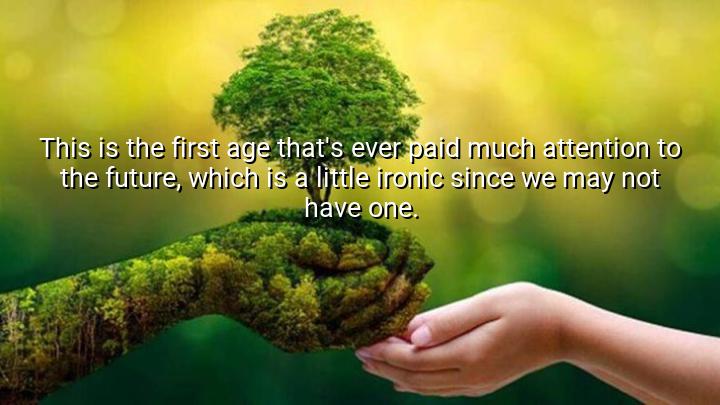




Arthur C. Clarke’s quote, "This is the first age that's ever paid much attention to the future, which is a little ironic since we may not have one," reflects on the paradox of modern society’s focus on progress and technology while simultaneously facing existential risks that could threaten humanity’s future. Clarke highlights that, unlike past civilizations, the modern age has become preoccupied with planning, predicting, and shaping the future, often through technological advancements and innovations. However, the irony lies in the fact that, despite this forward-looking mindset, humanity faces numerous threats—such as environmental destruction, nuclear warfare, and other global crises—that make the future uncertain and fragile.
The quote emphasizes the irony of our obsession with future possibilities when those very possibilities are threatened by the challenges of the present. Future-oriented thinking has become a hallmark of modernity, with scientific and technological fields constantly striving for advancements, yet this same future may be jeopardized by the very forces we create. Clarke’s reflection underscores the tension between optimism for what we can achieve and the realism that some of the challenges we face today might render those achievements irrelevant.
Arthur C. Clarke, a renowned science fiction writer and futurist, was deeply concerned with the direction in which humanity was heading, particularly in terms of space exploration and technological advancement. His works often explored themes of humanity’s relationship with technology, the potential for growth, and the risks that come with scientific progress. The quote captures Clarke’s skepticism about humanity’s ability to navigate the future successfully, given the unpredictable nature of our actions and their consequences.
In essence, Clarke’s quote invites reflection on our modern focus on the future and its inherent risks. It challenges the assumption that technological and scientific progress will automatically lead to a better future, instead pointing out that the very advancements that drive our attention to the future could also be the things that prevent us from having one. The quote highlights the need for caution, foresight, and responsibility as we shape the world we leave for future generations.

TTDang Thanh Thao
I find Clarke’s words surprisingly relevant, especially in an age where we're inundated with predictions—from climate models to AI futures. Yet despite our data and planning, the biggest threats remain largely unaddressed. Is it that we believe in the future too much, or that we’ve forgotten how fragile it is? This quote feels like a warning wrapped in wit. Are we paying attention, or just watching the countdown?
KANguyen Thi Kieu Anh
What a powerful paradox. Clarke's point makes me think about how modern life is defined by future-facing ambitions—economic forecasts, environmental models, even space colonization. But how often do we pause to ask whether that future is viable? Is our obsession with futurism a reflection of hope or denial? Perhaps it's both. This quote challenges us to balance vision with responsibility before the window to act closes.
TLNong Thu Lanh
I can’t help but feel a deep sadness reading this. It’s true—we’ve become obsessed with what’s next: smarter tech, longer lives, colonizing space. But the foundation we’re building on is crumbling. Clarke's irony forces us to confront a grim possibility: maybe we romanticize the future because we fear we’re losing grip on it. Are we dreaming of a better world as a way to ignore the one we’re damaging now?
HVHo Vy
This quote really hits a nerve. We're constantly planning, projecting, innovating—yet the existential threats we face seem to grow by the year. I’m left wondering: what does it say about a civilization that spends so much energy on imagining tomorrow while neglecting to secure it? Clarke’s irony speaks volumes about our priorities. Maybe the future we idolize is more fantasy than feasible path if we don’t act decisively now.
TNCong Truong Nguyen
Clarke’s observation is both clever and haunting. Isn’t it strange that with all our technological progress and obsession with forecasting, we're simultaneously inching toward potential self-destruction? Climate change, AI ethics, nuclear tension—it makes me wonder whether our awareness of the future is matched by the will to preserve it. Are we truly planning ahead, or just distracting ourselves with the illusion of control over a fragile timeline?