

This is at the heart of all good education, where the teacher asks students to think and engages them in encouraging dialogues, constantly checking for understanding and growth.
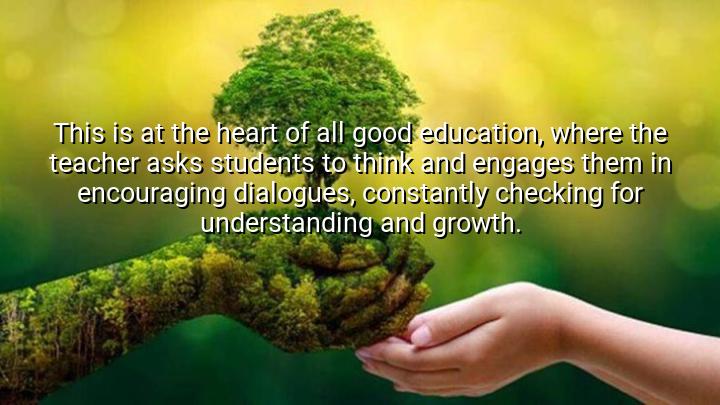




The quote “This is at the heart of all good education, where the teacher asks students to think and engages them in encouraging dialogues, constantly checking for understanding and growth.” by William Glasser emphasizes that true education is not about rote memorization but about fostering thinking, dialogue, and growth. Glasser highlights the role of the teacher as a facilitator who encourages students to reflect critically, rather than simply absorb information. This approach ensures that learning is meaningful and that students are active participants in their own development.
By stressing the importance of encouraging dialogues, Glasser underscores the interactive nature of effective teaching. A classroom should not be one-sided, with the teacher merely delivering information. Instead, discussion and feedback help students process ideas, clarify doubts, and deepen understanding. The act of “constantly checking for understanding” ensures that no student is left behind and that learning leads to real growth, both intellectually and personally.
The origin of this thought comes from Glasser’s work as a psychiatrist and educator, best known for developing Choice Theory and advocating for more humane, student-centered approaches to education. In his books, such as Schools Without Failure and Choice Theory in the Classroom, he argued that students learn best when they are respected, motivated, and engaged through active involvement rather than passive instruction. His philosophy challenged traditional authoritarian models of schooling, calling for a more cooperative relationship between teachers and students.
In essence, Glasser’s quote captures the core of what makes education transformative: it is not the transfer of facts but the cultivation of thinking minds. When teachers create a learning environment built on dialogue, encouragement, and understanding, they prepare students not just to succeed academically but to grow as thoughtful, responsible individuals.

AAdministratorAdministrator
Welcome, honored guests. Please leave a comment, we will respond soon