

Think back to yourself at age 18. I know I was mighty different than the Patti I am today. As we grow up, we grow out of our haircuts, our apartments and - often times - our romantic decisions.
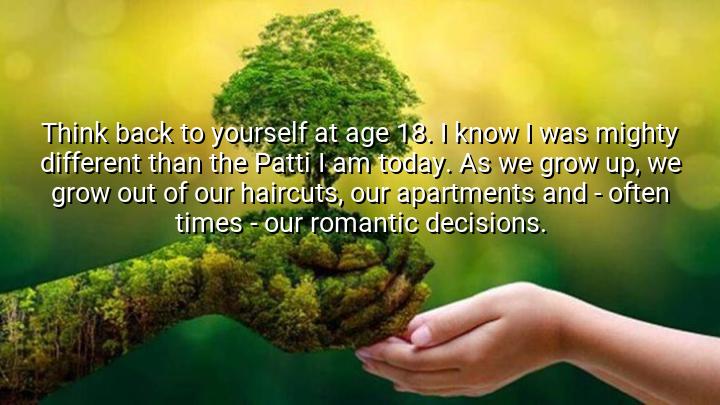




Patti Stanger’s quote reflects on the natural process of personal growth and how individuals change over time. She asks the reader to "think back to yourself at age 18," suggesting that, like most people, she has undergone significant changes in her life, both emotionally and physically. By saying, "I know I was mighty different than the Patti I am today," Stanger acknowledges that her values, decisions, and priorities have evolved as she’s matured.
The phrase, "we grow out of our haircuts, our apartments, and - often times - our romantic decisions," illustrates how our tastes, lifestyles, and relationships often shift as we age. Stanger uses the examples of haircuts, living situations, and romantic choices to highlight the superficial and deeper changes that occur. These elements, which may seem significant at one point, often become less relevant as we mature, signaling that the decisions and preferences of youth are often temporary and subject to growth.
Stanger’s reflection emphasizes how change is a constant part of life. She points out that many things that seemed important at a young age, such as fashion choices or certain relationships, may no longer hold the same weight as we gain more life experience. Her use of the term "grow out of" suggests that these shifts are not necessarily negative, but part of a natural process of self-discovery and maturation.
Ultimately, Stanger’s quote speaks to the inevitability of change as we grow older, encouraging an acceptance of how we evolve over time. It’s a reminder that we are not defined by past choices, and that personal growth involves shedding old habits, relationships, and even physical appearances as we continue to learn more about ourselves.

ATAnh Thai
I find this quote equal parts funny and profound. It’s easy to laugh at our past selves, but there’s something brave about acknowledging that we’ve changed. It raises an interesting question: if we keep evolving, how do we choose partners or life paths that grow with us? Is there ever a version of ‘us’ that feels fully settled, or are we always in motion?
HLVu Hong Loan
This made me think about how identity is so fluid. We often talk about big life changes, but Patti points out that even everyday things—like a haircut or an apartment—reflect who we are at different stages. Do we give ourselves enough credit for these small but meaningful evolutions? Sometimes they’re the most honest indicators of growth.
RHRi Ha
I appreciate how candid and humorous this is. But it also opens up a deeper conversation about how our values shift over time. What seemed thrilling or important at 18 often feels trivial or chaotic later on. It makes me curious—are there aspects of our younger selves worth holding onto? Or is adulthood just a process of refinement and release?
MGEbe My Giang
This quote really hits home. The idea that we grow out of not just material things, but also relationships, is powerful. It reminds me that letting go doesn’t always mean failure—it can just mean change. I wonder how much happier we’d be if we normalized the idea that outgrowing a romantic partner is part of personal evolution, not a sign of emotional immaturity.
ANHong Anh Nguyen
There's something comforting about this reminder that outgrowing things is natural, even necessary. But it makes me think—why do we often judge our past selves so harshly? I used to cringe at my younger choices, but now I try to see them as part of the journey. Is it possible to feel gratitude instead of regret for the earlier versions of ourselves?