

They seem to have forgotten that, and are back saying the only purpose of P2P networks is for illegal trading of owned goods. We claim part of the reason for P2P is for legal trading of what ought to be in public domain. And what is in public domain in many cases.
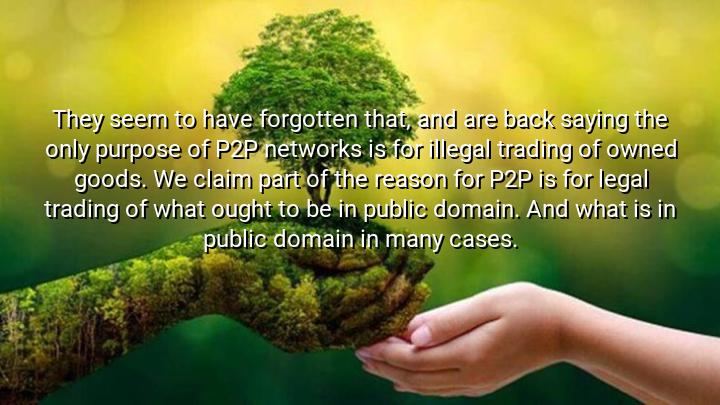




John Perry Barlow’s quote addresses the debate surrounding P2P (peer-to-peer) networks, which are often associated with the illegal trading of copyrighted material. He argues that many people have forgotten that P2P networks are not inherently designed for illegal activity, such as the unauthorized distribution of owned goods, but also serve as a legitimate platform for the legal trading of content that should be in the public domain. Barlow's statement challenges the narrative that P2P networks are only used for piracy, instead advocating that these networks also have a rightful role in distributing material that is freely available to the public.
The central argument in the quote is about the dual nature of P2P networks: while they can be used for illegal purposes, they also offer the potential for sharing and distributing information, art, and other content that is not protected by copyright law. Barlow suggests that many people fail to recognize that public domain content, which is free from copyright restrictions, can be freely shared and traded on these networks. His statement highlights the potential of P2P technology as a tool for promoting access to knowledge and cultural exchange rather than simply a medium for illegal file-sharing.
Barlow is also pointing out the misconception that P2P networks are solely used for illegal purposes. His claim suggests that part of the misunderstanding surrounding these technologies comes from a lack of recognition of their legitimate uses, especially for content that should not be restricted by copyright. By emphasizing that some content is already in the public domain, Barlow advocates for a more nuanced view of P2P networks, one that recognizes their potential for positive and lawful uses, such as the distribution of educational, historical, and cultural materials.
The origin of this quote comes from John Perry Barlow, an influential internet activist and co-founder of the Electronic Frontier Foundation (EFF). Barlow was an advocate for digital rights, free speech, and the free flow of information online. His work in the early days of the internet focused on defending the rights of internet users and ensuring that new technologies were not overly restricted by legal and governmental controls. This quote reflects his longstanding position on the role of technology in promoting freedom and access to knowledge.

AAdministratorAdministrator
Welcome, honored guests. Please leave a comment, we will respond soon