

There was no religious ceremony connected with marriage among us, while on the other hand the relation between man and woman was regarded as in itself mysterious and holy.
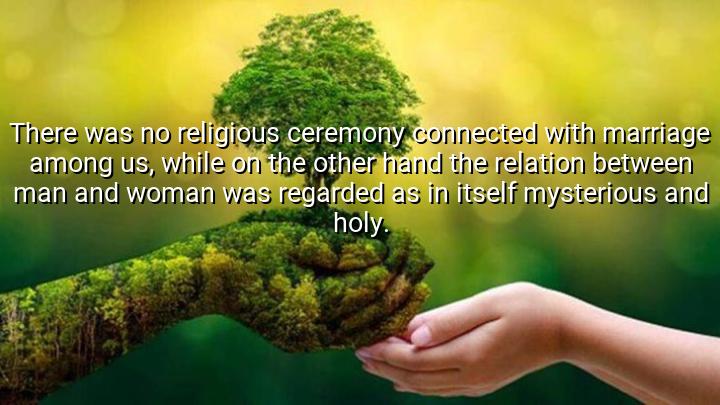




The quote by Charles Eastman reflects his perspective on marriage within traditional Native American culture. He explains that there was no formal religious ceremony tied to the union, unlike in many Western traditions where marriage is marked by rituals and blessings. Instead, the bond between man and woman was viewed as inherently mysterious and holy, suggesting that the spiritual significance of the relationship was recognized without the need for institutional or ceremonial validation.
The origin of this quote comes from Eastman’s writings about his experiences and heritage. As a Dakota Sioux physician, writer, and reformer in the late 19th and early 20th centuries, Eastman dedicated much of his life to preserving and explaining Native American traditions to wider audiences. His reflections often compared Indigenous customs with Western practices, highlighting the spiritual depth and simplicity of Native approaches to life, including relationships and marriage.
By emphasizing that marriage was sacred without external rituals, Eastman conveys the idea that the bond itself carried natural spiritual significance. This perspective challenges Western notions that sanctity must be conferred through institutions, suggesting instead that human relationships derive holiness from love, respect, and balance. It also reflects Indigenous beliefs in the interconnectedness of life, where natural bonds were seen as part of a broader spiritual order.
Ultimately, Eastman’s words reveal both a cultural contrast and a universal truth. While Western societies often rely on formal ceremony to validate unions, he highlights how some Indigenous communities recognized marriage as holy by its very nature. His quote reminds us that sacredness can exist outside institutions and that deep respect for human connection lies at the heart of many cultural traditions.

AAdministratorAdministrator
Welcome, honored guests. Please leave a comment, we will respond soon