

There is a quiet about the life of a farmer, and the hope of a serene old age, that no other business or profession can promise.
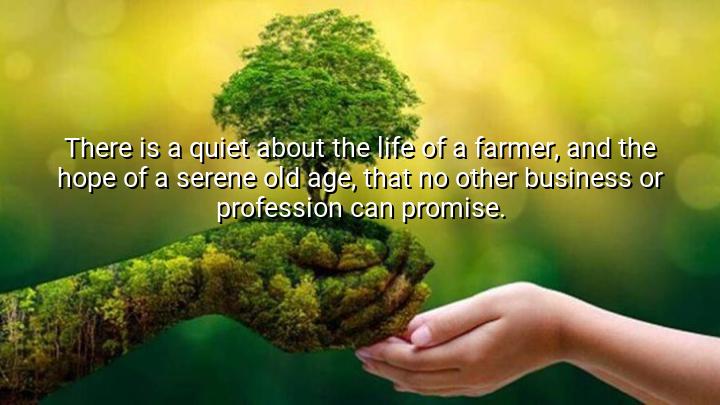




Robert Green Ingersoll’s quote, "There is a quiet about the life of a farmer, and the hope of a serene old age, that no other business or profession can promise," highlights the unique and peaceful aspects of a farmer’s life. Ingersoll suggests that farming, by its nature, provides a level of calm and solitude that other careers cannot offer. The work of a farmer is often tied to the rhythms of nature and the land, creating a life that is more connected to simplicity and the passing of time than the hustle of other professions.
The quote also emphasizes the hope of achieving a serene old age, which farming, with its grounding lifestyle, can promise. Unlike many fast-paced, high-pressure careers, the life of a farmer is often seen as one that provides a stable, fulfilling, and peaceful progression toward old age. Ingersoll contrasts this with other professions, which may not offer the same tranquility or the assurance of a calm and reflective later life.
Robert Green Ingersoll, a 19th-century American orator, lawyer, and agnostic, was known for his advocacy of freedom, reason, and human rights. His admiration for the life of a farmer reflects his appreciation for a life of simplicity and integrity, where the rewards are tied to personal effort and connection with nature. This quote encapsulates his belief in the value of a grounded, modest life and the quiet dignity that comes with it.
In essence, Ingersoll’s quote reflects the peacefulness and hope that the farming lifestyle offers—attributes often absent in more complex or commercially driven careers. It celebrates the idea that a life rooted in the land, with its focus on slow, steady work and natural rhythms, can lead to a fulfilling and serene old age.

UGUser Google
I admire the reverence in this quote for the farming life. It highlights a simplicity and dignity that many modern careers lack. But I wonder—what about the younger generation? With so few entering the profession today, does that serenity still attract anyone? Or has the promise of a peaceful old age lost its allure in a culture chasing speed and success?
VPle van phuc
As someone who grew up in a rural area, I feel both the truth and the myth in this statement. Yes, there is quiet and a sense of connection in farming. But there’s also backbreaking labor and emotional stress, especially during hard seasons. Does the promise of a serene old age depend on ideal circumstances, or can it be achieved despite the hardships?
GTGa Trum
Reading this makes me nostalgic for a slower way of life that’s becoming harder to find. The thought that farming could lead to a more serene old age is comforting. But is that serenity a result of the work itself, or the mindset it fosters—like patience, rhythm, and respect for nature? And can those values be applied outside of farming too?
BABui binh an
This line gives me pause. It’s a beautiful idea, but I think it glosses over how grueling and uncertain farming can be. My concern is whether this kind of thinking masks the economic struggles farmers often face. Can we truly speak of serenity when so many are burdened by debt, volatile markets, and physical tolls well into their later years?
FIfafaf iaiafafsaf
I find something deeply poetic in this view of the farmer’s life. It suggests a kind of spiritual reward for a life lived close to the land. But is that still possible in our modern world where farming is increasingly mechanized and corporate-driven? Has the profession lost that quiet simplicity, or can individual farmers still carve out that old-fashioned serenity?