

There has been enough suffering in our country, there has been enough of children whose dreams die before they have a chance to grow and there has been enough of our elders who, having served their nation, are forced into indignity in their old age.
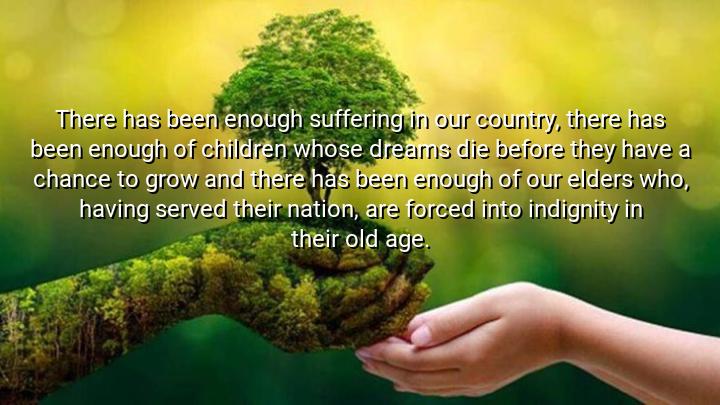




John Agyekum Kufuor’s quote highlights the ongoing suffering experienced by both the young and elderly in his country, particularly focusing on the harsh realities of poverty and neglect. He begins by acknowledging that there has been "enough suffering," underscoring the toll that difficult circumstances—whether economic, social, or political—have had on the people. Kufuor’s words express a deep concern for the challenges faced by those who are most vulnerable in society, such as children and elders.
The mention of children whose "dreams die before they have a chance to grow" is a poignant statement about the lost potential of youth who face poverty, lack of opportunity, or social inequality. Kufuor is lamenting the fact that many children, due to various circumstances, are not given the chance to fulfill their potential or pursue their aspirations. This also speaks to the need for education and opportunity for the next generation to thrive and contribute to the future of the nation.
Kufuor also addresses the plight of elders who, despite having served their nation, are left to face indignity and hardship in their later years. His words point to the societal failure to provide care and respect for those who have contributed to the country's growth, a sentiment that reflects a need for greater elderly care and appreciation for their contributions. This speaks to a broader societal issue of ensuring that elderly citizens are treated with dignity, especially after a lifetime of service.
Ultimately, Kufuor’s quote is a call to action, urging his country to address these deep societal issues. It advocates for a future where children are nurtured and given a chance to realize their dreams, and elders are honored and supported in their later years. The quote highlights the importance of creating a society where no one, regardless of age, is left behind or overlooked.

Kkhoa23112005
What really strikes me here is the emotional weight of the word 'enough.' It feels like both a plea and a demand. I wonder how many leaders truly internalize this kind of message when crafting policies. Do we need more empathy in politics, or is it about accountability? Either way, this quote underscores how essential it is to humanize the consequences of economic and social decisions.
UGUser Google
This quote feels like a powerful indictment of systemic failure. Children’s dreams and elders’ dignity should be fundamental pillars of any nation’s moral compass. But we often prioritize short-term gains over long-term human investment. What’s stopping governments from implementing lasting social safety nets? Is it lack of resources or lack of political will? The suffering described here demands more than just acknowledgment—it demands action.
VPthuy vy phung
This line really hits home, especially the part about elders being forced into indignity. It’s so painful to think that those who spent a lifetime building a country are often left behind. Why isn’t there more outrage about this? Shouldn’t a society be judged by how it treats its most vulnerable? It makes me reflect on how easily people become invisible once they age out of the workforce.
GDGold D.dragon
I find this deeply powerful and sadly still relevant in many places. But I wonder, what would a nation that truly values both its youth and elders look like in practice? Is it more investment in education and healthcare, or is it about reshaping how we measure national success? This quote feels like a call for compassion-driven policy, but I’m not sure how close we are to realizing that vision.
AQNguyen Anh Quan
This quote really moved me. It paints such a heartbreaking picture of both the young and the elderly being failed by the very systems meant to protect them. Why do we consistently see the same vulnerable groups—children and seniors—bearing the brunt of national hardship? It makes me wonder what kinds of reforms or cultural shifts are necessary to ensure dignity at both the beginning and end of life.