

There are three periods in life: youth, middle age and 'how well you look'.
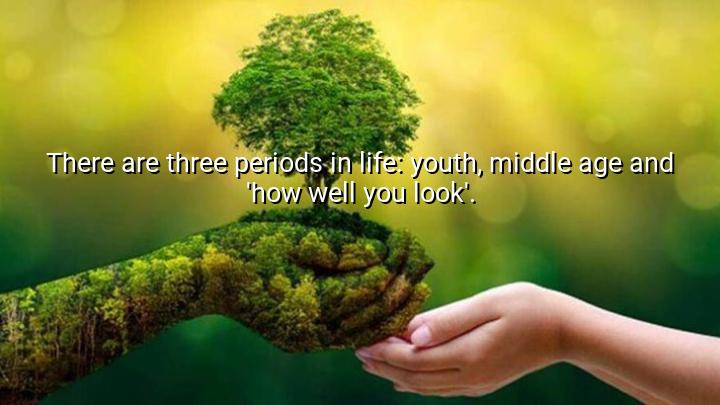




The quote "There are three periods in life: youth, middle age and 'how well you look'" by Nelson Rockefeller, an American businessman and former Vice President, offers a satirical reflection on how society tends to categorize life stages. Rockefeller humorously suggests that in addition to the natural periods of youth and middle age, society places significant emphasis on one’s appearance, particularly how one looks in relation to age. This perspective critiques the societal focus on physical appearance as a marker of value or success, often overshadowing more substantive qualities such as character, accomplishments, or personal growth.
By identifying youth, middle age, and "how well you look" as the three phases of life, Rockefeller highlights the obsession with aesthetic beauty and the pressures people face to maintain a certain image, especially as they grow older. In this view, the physical condition of one’s body or appearance becomes a defining factor, particularly in a culture where youthful beauty is often idealized. Rockefeller's comment plays on the idea that as people age, they are often reduced to their outward appearance, which reflects society's superficial standards.
The inclusion of "how well you look" as a separate stage also emphasizes the temporary nature of youth and the fluctuating perceptions of beauty throughout life. This part of the quote suggests that age itself may be less important than how others perceive you based on your appearance, which can change as one ages. It is a commentary on the way society places such value on external features, often neglecting internal growth, wisdom, and emotional maturity that come with time.
Ultimately, Rockefeller’s quote encourages reflection on how we value ourselves and others, suggesting that youth and middle age are natural stages of life, but appearance shouldn’t overshadow the deeper qualities that define who we are. His use of humor serves to critique a culture that prioritizes aesthetic standards over the more enduring aspects of self-worth.

HDHoang Dung
This quote is clever but also highlights a weird societal shift. Youth is full of potential, middle age is full of pressure, and after that — it’s all about appearances? That feels incredibly superficial. What does that say about our priorities? I think we need to redefine the third stage of life, not by looks, but by wisdom, freedom, and impact. Isn't that a better measure than skin-deep observations?
QQuyen
Rockefeller's quote made me laugh, but then I realized how much truth it holds in how people perceive aging. After a certain point, compliments stop being about your accomplishments and start being about how youthful you appear. Why does our culture praise people for 'not looking their age' instead of just embracing the beauty of aging naturally? It makes me wonder how much value we attach to authenticity anymore.
YXNguyen Ngoc Y Xuan
This quote hits on something that feels uncomfortably true. In the later stages of life, especially for women, the pressure to look younger often outweighs appreciation for wisdom or experience. Why is that? Is it vanity, or is it fear of being seen as irrelevant? I’d love to see a world where aging is celebrated not just when it looks good, but when it carries depth and dignity.
DHnguyen dac huy
I find this quote both witty and a little sad. It suggests that after a certain age, society doesn’t really care about your age, just how ‘young’ or ‘fresh’ you appear. Have we become so obsessed with youth that we reduce the complexity of aging to just how good someone looks for their age? Shouldn’t we be asking what people have *done* with their lives instead of how well they’ve preserved their faces?
TTLe Thuy Trang
This quote is sharp and kind of hilarious, but also painfully accurate. It makes me wonder — why does society place so much emphasis on appearance, especially as we age? It’s like once we’re out of the traditional ‘youth’ bracket, everything becomes about how well we’re ‘holding up’ rather than who we are or what we’ve learned. Is there a way to shift the conversation from looks to legacy?