

There are periods in history when change is necessary, and other periods when it is better to keep everything for the time as it is. The art of life is to be in the rhythm of your age.
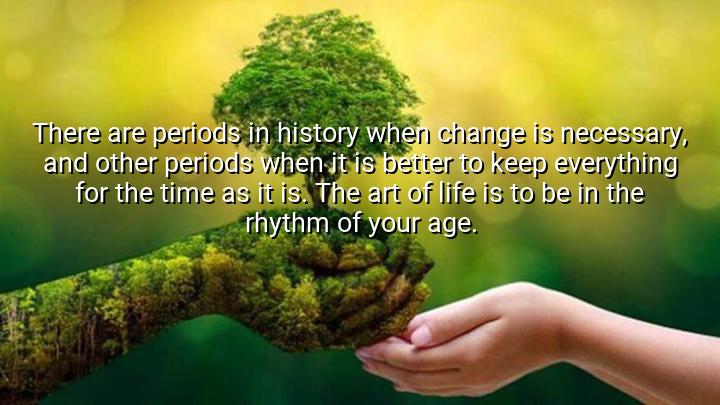




In this quote, Oswald Mosley reflects on the nature of change throughout history and the importance of recognizing when it is necessary to embrace change and when it is better to maintain the status quo. He suggests that there are certain periods in history when change is essential for progress, while at other times, it may be wiser to keep things as they are to preserve stability. Mosley emphasizes that the key to living effectively is understanding and aligning with the rhythm of the age you are in.
Mosley’s statement highlights the dynamic relationship between society and change. He believes that each historical period has its own needs and challenges, and it is the job of individuals and leaders to assess whether the times call for revolution, reform, or continuity. In this sense, the art of life involves not only being aware of the broader context but also responding to it in a way that is thoughtful and appropriate for the times.
The idea of being in tune with the rhythm of your age suggests that wisdom comes from adapting to the current social, political, or cultural climate, without blindly pushing for change or stagnation. Mosley implies that successful individuals and societies are those who can find the right balance, knowing when to embrace change and when to preserve tradition.
Ultimately, Mosley’s quote serves as a reminder to be mindful of the era you live in and to make decisions based on the context of the time. It encourages a flexible approach to life that acknowledges the ebb and flow of history and seeks to navigate it with awareness and adaptability.

VVanhInDaBlue
This really makes me reflect on our own moment in history. We’re dealing with climate crises, social upheaval, and massive tech shifts—so is now a time for change or for holding steady? The quote implies a kind of intuition or wisdom is needed to decide, but not everyone has the same instincts. Is there a way to teach people how to recognize those periods in history where action is truly necessary?
TTPhan Tan Tai
I see both wisdom and ambiguity here. The idea of tuning into the spirit of your era is attractive, but what if the spirit of the age is misguided? Take consumerism or online outrage culture, for example—should we conform to those too? Or is the 'art of life' more about discerning what is truly timeless within each era? I’d love to hear thoughts on how to interpret this in morally gray times.
HT37 Vo Ham Tien
It’s a beautifully phrased idea, but I’m not sure it holds up in practice. Today, with everything changing so quickly—technology, politics, culture—is it even possible to ‘be in rhythm’ with the age? Or does that phrase now mean something more like staying adaptable rather than aligned? I wonder how someone who resists modern norms entirely would interpret this. Could this quote actually justify both rebellion and conformity?
HHHoang Hien
This quote seems wise, but it also feels dangerously vague. Who gets to decide the ‘right’ rhythm of an age? Historically, many harmful ideas have been justified in the name of fitting the times. I'm curious how we distinguish between genuine societal progress and a mere obsession with change. Can clinging to tradition be just as radical as demanding transformation? Or is that just a romantic excuse for inaction?
NLNguyen Thi Ngoc Lan
I find this quote quite compelling. It makes me wonder—how do we truly know when it's time to push for change versus when it's wiser to preserve stability? It seems like such a delicate balance. In today’s fast-paced, innovation-driven society, is there still room to pause and appreciate continuity? I’d love to hear perspectives on how to recognize the ‘rhythm’ of our times without being swept away by every trend.