

There are mysteries which men can only guess at, which age by age they may solve only in part.
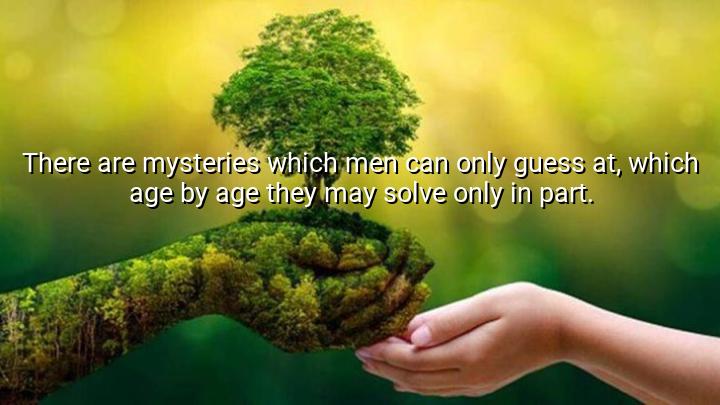




Bram Stoker’s quote, "There are mysteries which men can only guess at, which age by age they may solve only in part," reflects the idea that certain mysteries of life, whether they be philosophical, scientific, or existential, are beyond full understanding. Stoker suggests that humanity is constantly grappling with these mysteries, and over time, while we may make progress in solving them, we will never fully comprehend them. The use of "age by age" highlights the slow and incremental nature of human knowledge.
The quote also touches on the limits of human understanding and the ongoing quest for answers. Despite advancements in knowledge, certain questions remain elusive, and age and experience allow us to understand more, but never fully grasp every aspect of life's mysteries. Stoker implies that our pursuit of understanding is a lifelong endeavor, with each generation contributing to the broader puzzle, yet never reaching a definitive solution.
Bram Stoker, best known for writing the iconic novel Dracula, often explored themes of the unknown, mystery, and the supernatural. His works frequently delved into the realms of fear, the limits of knowledge, and humanity’s quest for answers to life’s deepest questions. This quote reflects his fascination with the limits of human understanding, which is a theme explored throughout his writing.
In essence, Stoker’s quote highlights the idea that mysteries are an inherent part of the human condition, and while we may make progress in uncovering their truths over time, some answers remain just beyond our reach. It speaks to the humility required in the pursuit of knowledge, recognizing that some aspects of life will always be beyond our complete comprehension.

DHDuc Huy
I can’t help but think about how this applies to things like love, death, or even consciousness—those endlessly puzzling human experiences. Maybe Stoker is suggesting that some truths aren't just waiting to be discovered but are meant to change shape with each generation. Is our role not to find the ultimate answer, but to keep the questions alive?
MPMai Phuong
This quote taps into something deeply philosophical. It makes me wonder about the nature of knowledge itself. Are some mysteries unsolvable because they are beyond logic, or is it that human consciousness hasn’t evolved enough to grasp them? It challenges the idea of human supremacy in understanding the universe and forces us to confront our limitations.
MKco cl ma khai
I find this idea both frustrating and comforting. Frustrating, because it suggests we’ll never fully know everything; comforting, because it means we don’t have to. There’s room for awe and for not having all the answers. But it also raises the question: how do we decide which mysteries are worth devoting lifetimes to, and which we should simply respect without trying to dissect?
TDThi Anh Tho Do
Reading this makes me feel small in the best way. It’s a reminder that human understanding has limits. But then again, isn’t that what keeps curiosity alive? If we ever fully solved life’s biggest mysteries, would we stop seeking? I think the quote challenges our need for certainty and encourages us to be at peace with the unknown.
Mmen
There’s a beauty in this idea, almost poetic. But it also makes me question—what are these mysteries Stoker alludes to? Are they spiritual, scientific, emotional? And why can they only be solved ‘in part’? Maybe some knowledge is meant to evolve with us over generations, and full comprehension might be too much for one lifetime to handle.