

The whole business of marshaling one's energies becomes more and more important as one grows older.
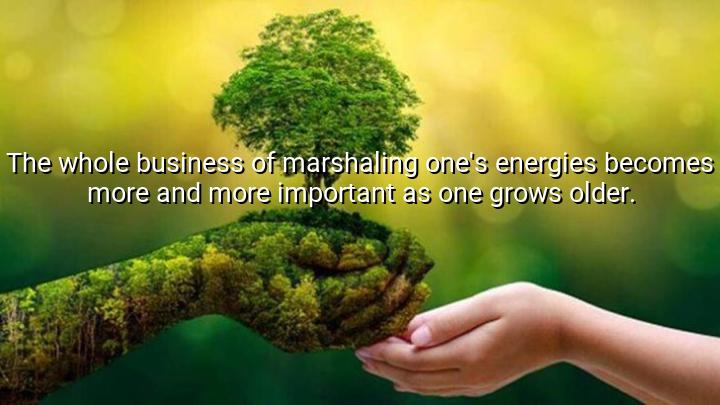




The quote "The whole business of marshaling one's energies becomes more and more important as one grows older" by Hume Cronyn speaks to the increasing importance of managing one’s physical, mental, and emotional resources as we age. Cronyn, a Canadian-American actor known for his work in theater and film, suggests that as we grow older, our energy levels naturally decline, making it essential to prioritize and carefully direct our efforts. In youth, we may have boundless energy to pursue various activities without much thought, but in older age, it's important to be more strategic and intentional about where we invest our time and energy.
Cronyn’s statement emphasizes the need for self-care and focus as we age. Marshaling one’s energies refers to the conscious effort of directing resources wisely, whether it's maintaining health, staying mentally sharp, or nurturing relationships. As we age, the demands of physical health and mental well-being can become more challenging, and it becomes crucial to conserve our energy for what truly matters. This process of managing one's vitality is not only about maintaining physical strength but also about keeping one's mind and spirit engaged and active.
The quote also highlights the necessity of prioritization as we grow older. In youth, we often have the luxury of spreading ourselves across many different activities, but in old age, it is important to focus on what brings the most value and fulfillment. Cronyn points out that the ability to direct our energy toward the things that truly matter becomes even more crucial, as our resources—in terms of time, energy, and health—become more limited.
Ultimately, Cronyn’s quote serves as a reminder that aging is not just about physical changes, but also about adjusting to those changes in a way that allows us to continue to live meaningfully. It encourages a more thoughtful approach to life as we age, where efficiency, balance, and self-awareness become key to maintaining a high quality of life in the later years.

TDTran Duc
What strikes me about this quote is how it reframes aging not as a decline, but as a call to focus. It’s no longer about doing everything, but doing what matters most. But it also raises a question: how do we identify what’s worth our energy as we grow older? Do our values shift naturally, or do we have to be intentional about reevaluating priorities?
TUNguyen Thi Tu Uyen
I find this quote incredibly grounding. It’s like a gentle reminder that aging isn’t just about slowing down—it’s about becoming wiser in how we spend our time and effort. But I wonder, how do we strike the balance between conserving energy and still living life fully? Is there a risk of becoming too cautious, too reserved, just because we’re trying to manage our diminishing reserves?
MULuong Thi Mai Uyen
This quote hits on something I’ve felt but never articulated. There’s a certain grace in learning to pace yourself as you age. You become more deliberate, maybe even more strategic. But I do wonder: is this adjustment always voluntary? Or is it forced by the body's declining energy reserves? I'd love to hear others’ thoughts on whether this shift is empowering or just a necessary concession to time.
NGNguyen Giang
I appreciate how Cronyn acknowledges the shift that comes with aging. It’s true, you start to realize energy is a limited resource. But it makes me think—should we be teaching younger people about this early on? Would life be more fulfilling if we learned to marshal our energy from the start, or is that wisdom that only comes with experience? Maybe part of youth is the luxury of spending energy freely.
KBDuong Nguyen Khanh Bang
This quote really resonates with me. As I get older, I’ve noticed that I can’t just throw myself into things like I used to. It’s not just about physical energy—it’s mental and emotional too. Prioritizing becomes essential. I wonder, though, is this a natural adjustment or a limitation we reluctantly accept? Do we lose something valuable in becoming more selective, or do we actually gain clarity and purpose?