

The ultimate lesson is that there is no immunity, no matter our age or the size of our retirement account, from going through constant cycles of integration and disintegration in which we are humbled and hopefully set to rights with the world again.
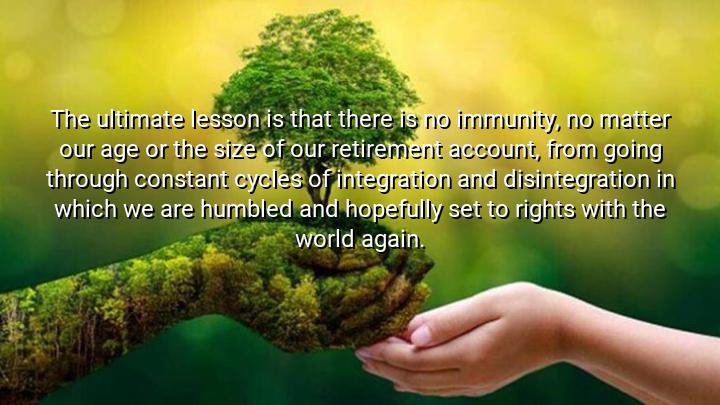




In this quote, David Whyte reflects on the universal nature of life's challenges and transformations. He suggests that there is no immunity from the cycles of integration and disintegration that everyone experiences, regardless of age or the size of our retirement account. The quote highlights the idea that life is an ongoing process of growth, decay, and renewal, where we are often humbled by setbacks and have to reassess ourselves and our place in the world.
Whyte’s use of integration and disintegration underscores the dynamic and often unpredictable flow of life. Integration represents moments of unity, balance, or alignment with ourselves and the world, while disintegration symbolizes times of struggle, loss, or upheaval. These cycles, according to Whyte, are part of the human experience, and no one is exempt from undergoing these changes, whether they are young or old, wealthy or not.
The quote also touches on the humbling aspect of life. Despite material success or age, no one can avoid facing moments that challenge their sense of self or their understanding of the world. These periods of difficulty are seen as opportunities for growth and self-correction, where we are “set to rights with the world again.” Whyte implies that through these challenges, we can emerge with a deeper sense of humility, wisdom, and balance.
Ultimately, David Whyte’s quote encourages us to embrace the natural ebb and flow of life’s cycles, understanding that they are essential to our personal growth and reconnection with the world. It serves as a reminder that no matter where we are in life or what we possess, we must remain open to the lessons that come from both success and failure. These cycles are not something to avoid but are integral to living fully and authentically.

LTLoan Le thanh
This quote makes me reflect on the myth of 'arriving' in life—like one day we’ll reach a stage where things stop falling apart. It’s freeing in a strange way to accept that we’re always evolving, breaking down, and reforming. But it also raises a question: how do we measure growth in such a cyclical process? Is progress still possible when stability isn’t guaranteed?
TNThaiduong Nguyen
What I appreciate most is the honesty in this message. It doesn’t sugarcoat life. Still, I’m curious—can repeated cycles of being humbled actually become damaging over time, especially for those already dealing with trauma or loss? Is there a limit to how much disintegration a person can take before they stop rebuilding altogether?
DKhuynh dang khoa
As someone nearing retirement, this quote gave me pause. I’ve worked decades to build a sense of safety, and hearing that nothing truly immunizes us from upheaval is a bit terrifying. How do we reconcile this truth with the human desire for security? Should we still plan for a peaceful future, or shift toward preparing for constant change instead?
MTnguyen thi minh tu
Whyte’s perspective makes me question our societal obsession with control and permanence. We pour energy into building stable careers, homes, and relationships—yet none of it can guarantee peace. So what’s the point of all this striving if change is constant and collapse inevitable? Is the real goal not achievement, but adaptability? That’s a radical shift in mindset I’m still trying to grasp.
DTDung Tran
I find this idea profoundly humbling. We often think success, age, or financial security might protect us from life’s lows, but that illusion can actually set us up for disappointment. I wonder: how do we learn to embrace these inevitable cycles without feeling like we’ve failed each time? Is there a way to celebrate the breakdowns as much as the breakthroughs?