

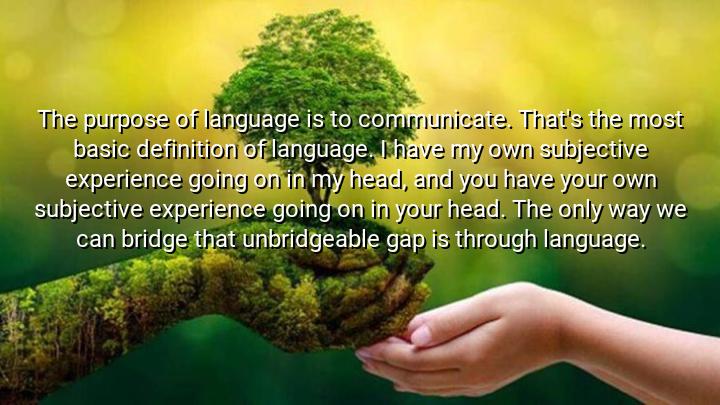
The purpose of language is to communicate. That's the most basic definition of language. I have my own subjective experience going on in my head, and you have your own subjective experience going on in your head. The only way we can bridge that unbridgeable gap is through language.
The purpose of language is to
The purpose of language is to communicate. That's the most basic definition of language. I have my own subjective experience going on in my head, and you have your own subjective experience going on in your head. The only way we can bridge that unbridgeable gap is through language.

The purpose of language is to
The purpose of language is to communicate. That's the most basic definition of language. I have my own subjective experience going on in my head, and you have your own subjective experience going on in your head. The only way we can bridge that unbridgeable gap is through language.
The purpose of language is to
The purpose of language is to communicate. That's the most basic definition of language. I have my own subjective experience going on in my head, and you have your own subjective experience going on in your head. The only way we can bridge that unbridgeable gap is through language.
The purpose of language is to
The purpose of language is to communicate. That's the most basic definition of language. I have my own subjective experience going on in my head, and you have your own subjective experience going on in your head. The only way we can bridge that unbridgeable gap is through language.
The purpose of language is to
The purpose of language is to communicate. That's the most basic definition of language. I have my own subjective experience going on in my head, and you have your own subjective experience going on in your head. The only way we can bridge that unbridgeable gap is through language.
The purpose of language is to

The quote by Michael J. Knowles emphasizes the fundamental purpose of language as a tool for communication. He points out that at its core, language exists to bridge the gap between individuals, each of whom has their own unique and subjective experience. Since our thoughts and feelings are personal and internal, language serves as the essential means by which we share and understand one another’s perspectives.

Knowles highlights the challenge of communicating because everyone’s inner experience is inherently unbridgeable—no two minds are exactly alike. Language becomes the bridge that allows us to connect across these differences, enabling us to convey ideas, emotions, and information despite our distinct mental worlds. This underscores the importance of clear and effective communication in human relationships.

The origin of this quote comes from Michael J. Knowles, a political commentator and author known for his reflections on culture, communication, and philosophy. His observations often delve into the nuances of human interaction and the vital role language plays in shaping society and understanding.

In summary, Knowles’s quote reminds us that language is more than just words; it is the crucial link that connects our individual subjective experiences. It serves as a reminder of the power and necessity of communication in overcoming isolation and building shared understanding.

Michael J. Knowles
Michael J. Knowles

American - Author Born: March 18, 1990

Have 0 Comment The purpose of language is to

AAdministratorAdministrator

Welcome, honored guests. Please leave a comment, we will respond soon

Reply.
Information sender
Leave the question
Click here to rate
Information sender
0.45179 sec| 2551.422 kb