

Many of the environmental rules not only fail to protect the natural environment, they actually increase the damage.
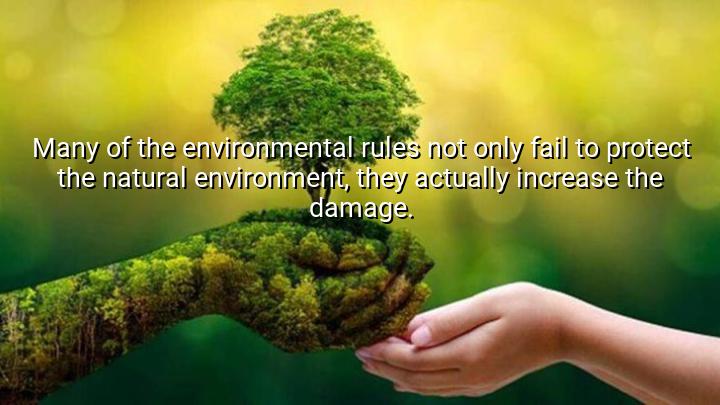




In this quote, Michael J. Knowles, a conservative commentator and author, criticizes certain environmental rules by arguing that they not only fail to protect the natural environment but may actually worsen the damage. Knowles suggests that some environmental regulations, perhaps in their attempt to address issues like pollution or resource depletion, may have unintended negative consequences. These regulations could either be poorly designed, overly restrictive, or fail to address the root causes of environmental harm, ultimately exacerbating the very problems they are meant to solve.
Knowles’ statement reflects a more skeptical view of government intervention in environmental issues, suggesting that regulatory frameworks can sometimes have counterproductive effects. For example, he might be alluding to cases where restrictions on certain industries lead to economic disruptions or where poorly crafted policies lead to inefficiencies in addressing environmental concerns. His critique implies that while the intentions behind these rules might be good, the execution or unintended consequences can result in even greater environmental harm.
The origin of this quote is rooted in Knowles' broader political and ideological perspective, which is often critical of big government and its impact on both the economy and the environment. Knowles, who has written about political issues and environmental topics, argues for a more market-driven approach to solving environmental challenges, as opposed to relying heavily on regulation. His stance challenges the conventional wisdom that regulations are always the best solution to environmental problems, advocating for alternative methods that might include innovation and private-sector involvement.
Ultimately, Knowles’ quote raises important questions about the effectiveness of environmental policies and whether they truly achieve their intended outcomes. It emphasizes the need for smart, effective regulations that don’t inadvertently cause more harm than good and calls for a careful examination of how policies are crafted and their long-term effects on both the environment and society.

AAdministratorAdministrator
Welcome, honored guests. Please leave a comment, we will respond soon