

The only violence was when these so-called 'freedom fighters' terrorized the poor Africans in the villages... They were told what to do and who to support.
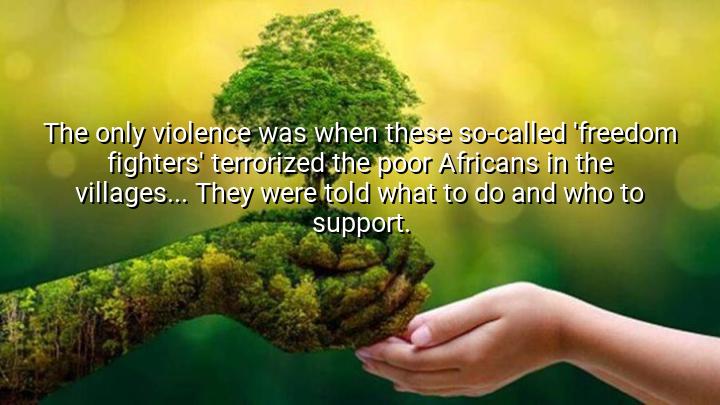




In this quote, Ian Smith, the former Prime Minister of Rhodesia (now Zimbabwe), discusses the violence associated with the freedom fighters during the country's liberation struggle. He describes how these fighters, whom he refers to as "so-called freedom fighters," used terrorism and coercion against the local African population in rural villages. Smith argues that these individuals, rather than genuinely fighting for freedom, were imposing their will on the people, forcing them to support a cause they may not have agreed with.
Smith's perspective reflects his view that the violent tactics used by the insurgents were not justified by the ideals they purported to fight for. He suggests that the so-called freedom fighters manipulated and threatened the African people, telling them who they should support and how they should behave, often through intimidation and force. This narrative contrasts with the broader portrayal of the liberation movement, which was seen by many as a fight for independence from colonial rule and oppression.
The quote highlights Smith's stance against the ZANU (Zimbabwe African National Union) and ZAPU (Zimbabwe African People's Union) factions, which led the armed resistance against his government. Smith, who represented the interests of the white minority government in Rhodesia, often portrayed the struggle for independence as unjust and marked by terrorism, rather than a legitimate fight for self-determination. His words reflect his belief that the insurgents were not true advocates of freedom but instead used violent methods to control and manipulate the population.
Ultimately, Smith’s quote reflects his political and ideological stance during a turbulent period in Zimbabwe’s history. He frames the freedom fighters as aggressors, using violence to achieve political ends, while positioning the white minority government as the protector of peace and order. This viewpoint has been widely criticized and contested, particularly by those who view the liberation movements as legitimate struggles for independence and human rights.

AAdministratorAdministrator
Welcome, honored guests. Please leave a comment, we will respond soon