

The older generation had greater respect for land than science. But we live in an age when science, more than soil, has become the provider of growth and abundance. Living just on the land creates loneliness in an age of globality.
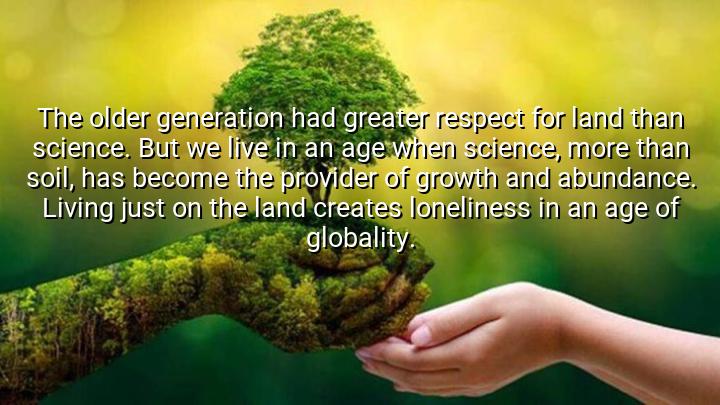




Shimon Peres’ quote, "The older generation had greater respect for land than science. But we live in an age when science, more than soil, has become the provider of growth and abundance. Living just on the land creates loneliness in an age of globality," reflects on the shift from traditional agricultural lifestyles to modern, technologically-driven societies. Peres contrasts the values of older generations, who had a deep connection to the land and relied on it for sustenance, with the present era, where science and technological advancements are the primary drivers of progress and growth.
The quote highlights how science has taken the place of the soil as a primary source of abundance and prosperity, particularly with innovations in agriculture, medicine, and other technologies. Where previous generations focused on working the land, today’s world emphasizes the role of scientific advancement in addressing issues like food production, healthcare, and environmental management. This marks a shift in how societies generate wealth and meet the needs of their populations, from natural resources to technological innovation.
Peres also touches on the isolation that comes with living on the land in the modern world. He suggests that in an age of globality, where globalization connects people across the world through technology, living in rural, agrarian settings can lead to loneliness. The expansion of global networks and digital communication contrasts sharply with the solitude of rural life, making it harder for individuals to connect with the larger, more interconnected world around them.
In essence, Peres’ quote explores the tension between tradition and modernity, where the old reliance on nature and land is being replaced by an era dominated by science and global connections. It reflects on how technological advancements have transformed both the ways we live and the way we relate to the world, offering both opportunities and challenges for individuals in an increasingly interconnected society.

MMMdnfnmnfnfn Mdnfn
This quote makes me think of generational identity. Older generations found purpose and pride in working the land, while younger ones look to innovation and global opportunity. Neither is wrong, but the transition creates a cultural gap. How do we bridge the values of the past with the demands of the present? Can new generations rediscover a respect for land even in a tech-driven era?
TTsjdghddh
Reading this, I’m left with a bittersweet feeling. I appreciate what science offers us, but I miss the romanticism of a life tied to land, seasons, and community. Have we become too reliant on synthetic growth—be it economic, agricultural, or digital—and forgotten the quiet, slow wisdom that comes from living close to nature? Does global connectivity mean much if we feel personally untethered?
VTPham Van Tung
This quote raises a complex issue: progress vs. preservation. It’s true that science brings abundance, but it also brings environmental degradation and social fragmentation. I wonder how we can regain respect for the land without rejecting technological advances. Is there a way to create harmony between nature and science so that we don’t have to choose one over the other in the pursuit of growth?
PDNi Nguyen Pham Duy
What strikes me is the statement about loneliness. It feels like a quiet acknowledgment that modern life, for all its conveniences, can feel disconnected. The land used to anchor people—to place, to rhythm, to each other. Now, with everything digitized and urbanized, do we even know what that grounding feels like anymore? Is our abundance coming at the expense of meaning and rootedness?
NQPham Nhu Quynh
I find this perspective thought-provoking. Science has undoubtedly improved life—medical breakthroughs, communication, even agriculture—but at what cost to our connection with the Earth? The idea that land once provided both livelihood and identity is powerful. In today’s hyperconnected world, are we more informed but more isolated? Does relying on science alone create a psychological and spiritual void that a connection to land once filled?