

The natural flights of the human mind are not from pleasure to pleasure, but from hope to hope.
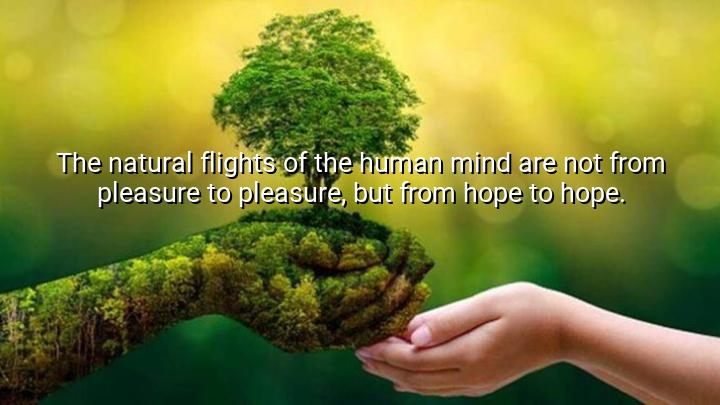




The quote by Samuel Johnson, an English writer and lexicographer, suggests that the fundamental movement of the human mind is not driven by the pursuit of fleeting pleasures, but rather by the continual desire for hope. Johnson implies that while moments of pleasure may provide temporary satisfaction, the deeper and more enduring force that motivates us is the constant yearning for something better, something to look forward to. The mind, in this sense, is always moving forward, guided by hope rather than contentment.
Johnson’s observation reflects a key aspect of human nature: we are often propelled not by the satisfaction of our immediate desires but by the anticipation of what might come next. Hope, for Johnson, represents a driving force that keeps individuals looking ahead, believing in the possibility of improvement or fulfillment. This focus on hope often leads to personal growth, as people continue striving for new goals and aspirations, even after their immediate desires have been met.
The quote speaks to the existential reality that humans are constantly in a state of desire—we are rarely satisfied for long, always searching for the next hope to sustain us. This could be interpreted as a commentary on the transitory nature of pleasure, which is often fleeting, while hope offers a more lasting form of motivation. Hope has the power to propel individuals forward, even in the face of challenges or uncertainty.
In essence, Johnson's quote suggests that human fulfillment is not necessarily found in the fleeting experiences of pleasure, but rather in the perpetual pursuit of hope—a continuous journey of looking toward the future with optimism. This perspective highlights hope as a vital, sustaining element of the human experience, one that keeps individuals engaged in life’s ongoing challenges and possibilities.

AAdministratorAdministrator
Welcome, honored guests. Please leave a comment, we will respond soon